

Garden Club of Cape Coral | Florida fall favorites
By SHERIE BLEILER
news@breezenewspapers.com
If you’re looking for fall like you experienced “up north,” where hard freezes turn leaves brilliant red and gold before they fall, you might assume Cape Coral doesn’t have a fall season. Without a freeze, most of our plants just continue growing.
Yet, we do have some fantastic seasonal color. Some plants with fall blooms and bright berries wait until fall to put on a show.
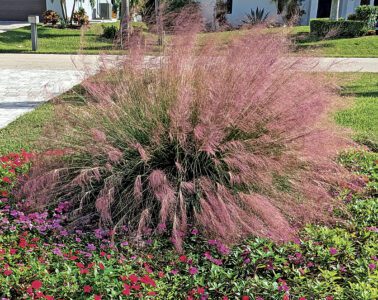
One of my favorites is muhley grass, with leaves about 3 feet high during the year. Yet in the fall, mauve cloud-like blooms rise up to 5 feet, swaying in the breeze. Soon you can admire muhley grass beginning to bloom in the median along Coronado Boulevard north of Cape Coral Parkway, as well as on the Cape Coral Police Department’s property along Cultural Park Boulevard. Once the blooms fade, February is a good time to trim them down to about 6 inches. This simulates the fire that would naturally occur in the dry season in pine flatwoods. A couple of weeks after trimming, they will already be flush with green leaves. Be on the lookout for other grasses that also put up their blooms in the fall and look their finest from October to December.
Asters bloom in late fall when many other flowers have gone to seed, providing late season nectar for our pollinators. Climbing aster grows well in our climate, covering itself with fragrant lavender flowers in late November to January. It gets so heavy it tends to fall over unless it has a fence to lean on. It is a perennial shrub that grows all year long, year after year. In the spring, after the blooms are finished, trim it way back.
Chrysanthemums, also in the aster family, struggle in the tropical heat and summer humidity of the southern half of Florida. Native primarily to temperate regions of China, garden mums can provide some autumn color, but generally prove short-lived in our gardens.
If you have explored the preserve trails across Lee County, you have probably noticed beautyberry growing beneath the forest canopy. It is a shrub about 4-8 feet tall, growing in sun or shade and striking in the fall-winter for its bright purple fruit. A mature beautyberry has long, arching branches that will weep toward the ground. In fall and winter, dense clusters of vivid purple berries encircle its stems, providing a vital food source for cardinals, blue jays, mockingbirds and woodpeckers. The plant is briefly deciduous in late winter, making the striking fruit stand out even more.
Another fall berry appreciated by birds is found on firebush, a keystone plant for both local birds and pollinators. Actually, there are many native plants providing berries this time of year.
Goldenrod’s tall yellow blooms are best in late summer and fall. With it in your neighborhood, the ecosystem has a big boost in biodiversity. It supports many native bees and caterpillars, plus the seeds in late winter are food for birds. Its pollen is carried by insects, not the wind, so it does not contribute to seasonal allergies.
Muhley grass, climbing aster, beautyberry, firebush and goldenrod are all native to Florida, exploding with color in the fall. They flourish in our naturally sandy, nutrient-poor soil without extra water or fertilizer. The first year, however, they will need supplemental water when it is dry until they establish deep root systems.
Florida is home to some of the most remarkable plants on earth. With houses and parking lots taking the place of native Florida, protect it by adding a couple of these fall bloomers for the birds and the bees.
Fall is a great time to plant! The Garden Club of Cape Coral will be one of the participants at the Tropical Plant Sale from 9 a.m. to 2 p.m. Saturday, Oct. 17, at Rotary Park, at 5505 Rose Garden Road, Cape Coral. You will discover a large variety of interesting plants for sale.
Sherie Bleiler is past president of the Garden Club of Cape Coral, and she volunteers at the butterfly gardens at the Cape Coral-Lee County Public Library and Sands Park. For more information, visit gardenclubofcapecoral.com. Like us on Facebook and Instagram.