

Garden Club of Cape Coral | ID’ing macronutrient deficiencies in palms
By JANETTA FOX
news@breezenewspapers.com
When looking to diagnose the cause of nutrient deficiencies in landscape palms, you can best start by determining whether issues are observed on older or newer fronds, or leaves. Older fronds may exhibit symptoms associated with insufficient levels of one or more macronutrients available for intake by the palm. While sufficient levels of nitrogen and phosphorus could be lacking in the soil, it is more likely that symptoms will arise from insufficient levels of potassium and/or magnesium. Therefore, potassium and magnesium deficiencies will be the focus of today’s column. Symptoms of micronutrient deficiencies found on newer fronds will be addressed in a future column.
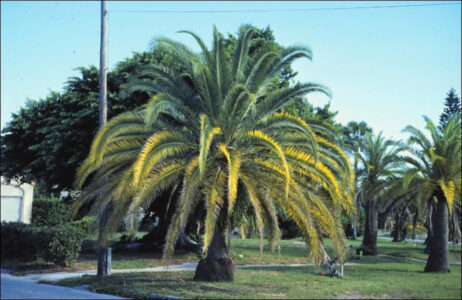
Potassium is critical to a palm’s ability to intake water from its root system and manufacture food through photosynthesis. It strengthens the palm’s resistance to common stressors, such as pests and disease. Typical symptoms associated with an insufficient amount of the nutrient in the soil may include yellowing of older fronds, brown leaf tips and yellow-orange spotting of fronds. Without intervention, the situation will worsen, eventually encompassing the entire canopy as the palm withers and dies.
Early detection is extremely important. For mild cases, a consistent quarterly application of palm fertilizer should suffice. More serious cases, often indicated by frizzled leaves, may require the quarterly application of sulfer-coated potassium sulfate and kieserite over a period of time, followed by a balanced palm fertilizer. Specific amounts and duration can be found at https://edis.ifas.ufl.edu/publication/EP269.
In both cases, be prepared to wait until the palm rids itself of affected fronds and begins producing new, healthy foliage. This could easily take well over a year. Per guidance from the University of Florida Institute of Food and Agricultural Sciences (UF/IFAS), avoid the compulsion to remove affected leaves before they completely die as it has been seen to inadvertently accelerate the palm’s decline.
Nitrogen promotes new growth, and magnesium is needed for healthy green foliage. When nitrogen, potassium and magnesium are misaligned, issues can easily arise. For example, an excess of nitrogen in the soil, caused at times by the application of turf fertilizer too close to the palm’s root system, can diminish the availability of both potassium and magnesium in the soil.
Symptoms of a potassium deficiency have already been addressed, but what about magnesium? First, it is important to note that, unlike with potassium, magnesium deficiencies, if left unattended, are not lethal for palms. You may observe yellowing along the margins — edges — of older fronds, working their way inward. At the same time, leaf veins — centers — remain green. You may also notice that the palm in question appears less hardy than others in the landscape.
To address magnesium deficiencies, UF/IFAS recommends ensuring your fertilizer contains the necessary percentage of the nutrient in slow-release form. If there is a severe deficiency, adding a regimen of kieserite at a minimum of quarterly is advised. Be prepared to wait a year or more for the palm to self-correct as the older fronds die off and are replaced by new, healthy growth. Treatment details can be found at https://edis.ifas.ufl.edu/publication/EP266.
While nutrient deficiencies can be associated with the inappropriate application of palm fertilizer, other factors, such as high alkaline soil pH, water retention due to poor drainage, water leaching, weather-related occurrences and excessive pruning, may be at play. The latter I have noted all too often, with healthy fronds removed to create that not so attractive ‘hurricane cut.” This practice only serves to weaken the palm.
While nutrient deficiencies are often the cause of palm decline, avoid assuming every issue is a nutrient issue, since various nutrient, insect and disease problems can mimic one another. For example, lethal bronzing disease could initially be mistaken for a potassium deficiency.
When in doubt as to what the symptoms of palm distress may indicate, you are encouraged to contact your local county extension office for guidance. For Lee County, you can visit the office at 3410 Palm Beach Blvd., Fort Myers, or send an email with sufficient details to fynlee@ifas.ufl.edu. A Master Gardener volunteer will respond to your query.
Janetta Fox is a member of the Garden Club of Cape Coral and a Lee County Master Gardener volunteer. For more information, visit gardenclubofcapecoral.com. Like us on Facebook and Instagram.