

Garden Club of Cape Coral | Building a Florida-Friendly garden: Part 7
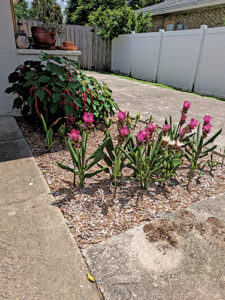
Hello fellow gardener, welcome back! I thought it would be fun to take you back to the area that I wrote about in my second column to see how it’s progressed.
It was a small, scrappy plot right next to my garage that had quite a bit of pea gravel from 47 years of accumulation! Amendments to the soil were made, and I planted crotons (Codiaeum variegatum “Mammy”), dwarf ginger (Costus woodsonii) and curcuma (Curcuma caesia). The planting was done in early February, so this is a seven-month check-in.
The crotons, unfortunately, wound up being potted and are awaiting a new home. Probably in the backyard area or maybe near the mailbox, depending on where I think they’ll thrive the best. In their place, there’s now a wonderful chenille plant (Acalypha hispida), also known as red-hot cattail. It flowers year-round, producing fuzzy red droopy blooms that work well with the taller purple and white curcuma in the foreground. The curcuma has performed exceedingly well! It’s already starting to multiply and fill in, which is exactly what I had hoped for!
The ginger hasn’t done as well as I had hoped for, but I believe it’s because I left it in the bucket too long before I planted it. It was given to me by a fellow Master Gardener. I brought it home and put it on the side of the garage and just didn’t get to it in a timely fashion. Lesson learned. I’m fortunate to have access to several more to fill in the area and plan to do that within the next several weeks.
It’s always good to check your plants periodically, especially with the heat we’ve been enduring — and the periodic rainfall. Speaking of rainfall, how are you watering your plants when there’s no rain? I have three rain barrels set up around my house. One is on my lanai, which I use for both my houseplants and lanai plants. There’s also one rain barrel on each side of my house, just off the front.
Rainwater is so much better for plants than tap water because it is naturally soft, slightly acidic and free of the harsh treatment chemicals found in municipal water. Tap water contains added treatment chemicals like chlorine and fluoride that can harm soil microbes and damage sensitive roots or leaf tips. Municipal water often contains dissolved minerals and salts that accumulate in soil over time, which stunts plant growth.
Consider that nature provides for its plants with rainwater. There are two spigots on my rain barrel. The bottom one I can hook to a hose with a spray head. It does run very slowly, so I’m thinking of adding a small submersible pump to the inside of the barrel. The top spigot accommodates a bucket underneath, which allows me to use a watering can or pitcher to water my houseplants. The two rain barrels on the sides of the house are used with hoses.
Meryl O’Rourke is a UF/IFAS Master Gardener. She volunteers at the Berne Davis Botanical Garden and the Goodwill Pathways to Opportunity Food Garden.
To reach MERYL O’ROURKE / news@breezenewspapers.com, please email