

Garden Club of Cape Coral | It’s always something
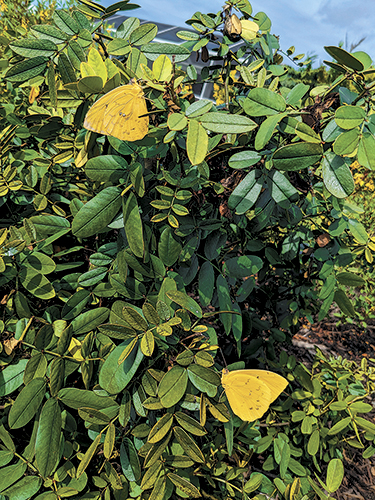
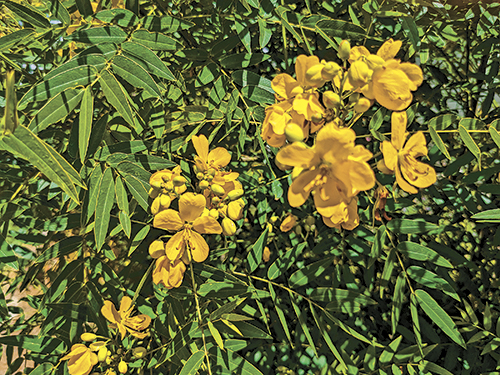
I have been enjoying watching the yellow sulphur butterflies swirling around my senna bushes from the coolness of the air conditioning. It looks like they love this heat. While the bushes will not bloom until it gets cooler in the fall, the butterflies are busy laying eggs on this host plant, giving me a good show.
There are several kinds of senna bushes. I have a Florida native one called a privet senna. All was going well until a few months ago when something started killing the ends of the branches. It looked like someone had burned the tips. The leaves were killed and a blackened stump remained on many branches. Something was killing the bush.
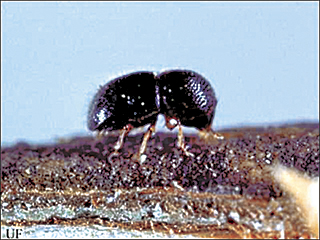
I did some investigating and discovered the culprit: a tiny beetle, the black twig borer. Only 1/16th inch long, the little female makes a hole on the underside of a twig, lays 10-15 eggs and stuffs it with spores of ambrosial fungus (Fusarium solani). They are sometimes called ambrosia beetles. The fungus grows on the inside of the twig and feeds the larvae. They stay in the twig cavity until they emerge as adult beetles, which takes a month. The black fungus stops the sap from flowing in the stem, killing the stem and turning it black.
Have you seen this on any of your other plants? Because as it turns out, these beetles are not picky! At least 224 plant species are susceptible, including orchids, hibiscus, star jasmine, live oaks, red maple and southern magnolia. Fruit and nut trees, including avocado and mango, can also host the beetles.
What can we do?
First, take good care of your plants to keep them strong. Avoid overfertilizing and water when dry. The severe drought we had this spring and early summer may have weakened the bushes and made some more susceptible to the beetle. However, these beetles will attack healthy plants, too.
Watch for early signs. Beetles drill a hole on branches less than an inch in diameter. Wilting of the leaves may occur two weeks after the beetle boars a hole and lays the eggs. On avocado trees, you may notice a white substance coming out of a hole in the twigs. In my case, my first clue was the blackened ends of the branch. Beetles tend to show up more at the flush of new growth, so be especially vigilant as new leaves appear.
Prune and eliminate. Prune the twigs 4 inches below the affected area. Dispose of all material immediately. Do not drop them on the ground or more may emerge and continue infecting your plants. This is the most effective strategy.
Chemicals. Once a plant is infested, the beetles cannot be killed within the plant with insecticides, nor can the fungus be killed with fungicides. Therefore, do not apply a soil drench with imidacloprid because the beetles do not eat the wood or sap from the plant. However, you may use a protective spray to a susceptible plant — before beetles arrive — with products containing permethrin or bifenthrin that are labeled for spraying on limbs.
I hope none of you ever need to worry about this little beetle. I hope your flowers and fruit grow beautifully this fall. Soon the privet senna bushes will begin to form flower buds. But I will be watching for signs of this tiny invader!
Sherie Bleiler is past president of the Garden Club of Cape Coral. She volunteers at the Cape Coral Library’s butterfly garden and Sands Park’s butterfly garden. For more information, visit gardenclubofcapecoral.com. Like us on Facebook and Instagram.