

Garden Club of Cape Coral | Blue flowers bring subtle beauty to the butterfly garden
By JAN BARGMANN
news@breezenewspapers.com
I plant my garden to attract butterflies, and blue flowers catch my eye the most. Among the reds, yellows, whites, pinks and salmon blooms, blue is less common. It adds a special touch to the garden. Several Florida-friendly plants in my landscape provide those blue flowers while also supporting pollinators.
One of the prettiest Florida-friendly plants in my garden is blue daze. Evolvulus is the genus, and this plant is native to Brazil. In my yard, blue daze has served as a border around a designated garden plot, though recent changes moved the plants to a different location.
UF/IFAS recommends planting blue daze in groupings of 10 to 12 plants when it is used as a border. Because it is hardy and attracts pollinators, it is a favorite among local gardeners. Blue daze and the newer cultivar Blue My Mind are available at local nurseries and are recommended by UF/IFAS for Florida-friendly Landscaping. Both are non-invasive. For detailed information on this flower, see the UF/IFAS blog “Blue for your Florida landscape” by Ralph Mitchell.
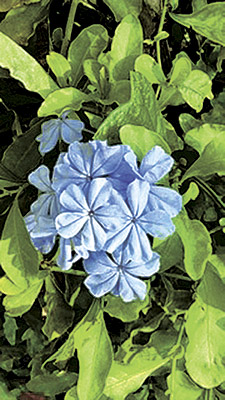
Blue plumbago produces an abundance of clustered blue flowers, especially during the spring-through-fall growing season. It is drought tolerant but does not like poorly drained soil. Be ready with the pruning shears, as this plant grows quickly and will require frequent pruning if planted in a confined space. Plumbago grows best in full sun, but it will grow in partial sun, too. Suggested uses include a showcase plant cascading over a retaining wall, hedges or planters. Blue plumbago attracts various butterflies, including the giant swallowtail, gray hairstreak, gulf fritillary and monarch.
Additionally, it serves as a host plant for the larvae of the Cassius blue butterfly. See south-florida-plant-guide.com for more information.
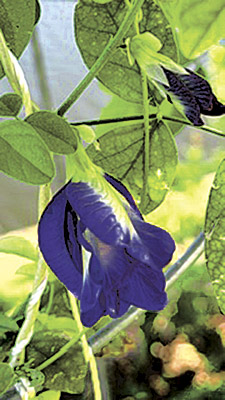
Nurturing is the part of gardening that prompted me to plant a seed from a blue pea vine. It grew and is now producing dark blue flowers on a trellis. Called the butterfly pea, it grows best in 6 to 10 hours of direct sun.
It tolerates most soil types but prefers sandy, well-draining soil with a pH of 6.0 to 8.0. The butterfly pea is a perfect flower because it has perfect flowers, which are self-pollinating. The peas are not considered palatable though the flower is edible and is best when first open.
In addition, flowers are used as a natural blue colorant. When the flowers wilt, dry them completely, and use them as a colorant when mixed with hot water. I found the UF/IFAS publication Butterfly Pea (Clitoria ternatea) Flower Extract (BPFE) and Its Use as a pH-Dependent Natural Colorant very informative.
Blue porterweed is another flower in my garden. Hardy in zones 10 and 11, this native species is highly drought tolerant and can be planted in full sun. Porterweed is not a showy plant, but it does serve as a butterfly attractor. The white peacock is one of the butterflies that like porterweed. Monarchs, gulf fritillaries, red admirals and clouded skippers use porterweed as a nectar source. The tropical buckeye uses porterweed as a host plant.
Porterweed grows best in full sun to minimal shade and in well-drained sand, clay, loamy or calcareous soils. Drought tolerant and moderately salt tolerant, it serves well as a ground cover or in a wildflower garden, and it also can be grown in containers. The native species has a prostrate, sprawling growth pattern and looks best if old growth is kept trimmed.
The Florida Wildflower Foundation published this caution about porterweed: The non-native Stachytarpheta cayennensis is often mistaken for the native species because both have distinctive purplish-blue flowers. S. cayennensis, however, is recognized as a Category II invasive species because it has escaped cultivation and is altering native habitats. It should not be used. S. cayennensis has a more erect habit than the native species, which has a more prostrate habit. Be sure to purchase plants from trusted sources to ensure you are getting the native species.
Jan Bargmann is a member of the Garden Club of Cape Coral and a Master Gardener Volunteer with UF/IFAS Extension in Lee County. Visit gardenclubofcapecoral.com. Like us on Facebook and Instagram.