

Garden Club of Cape Coral | Search and find
By SHERIE BLEILER
news@breezenewspapers.com
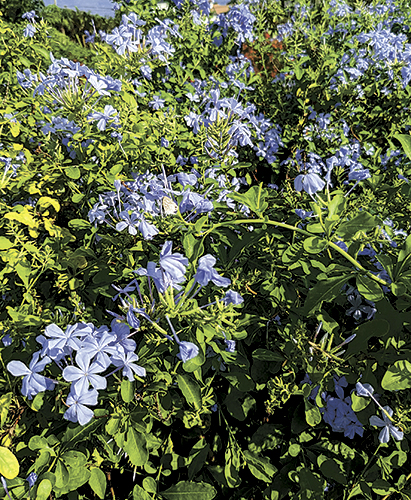
You cannot be blamed for missing these tiny bundles of energy. But if you stop to observe a blue plumbago bush, you might notice some activity. It is hard to make out if it is a fly or a flake of ash blown by the wind.
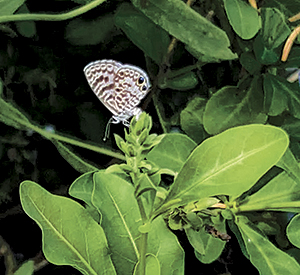
Watching closely, after seeing the erratic movement, you may see it land briefly. It is a small butterfly with a one inch wingspan and gray and cream stripes on the underside. As it darts away, you may briefly see the light blue top side of the wings. It’s blue!
This is a cassius blue butterfly, which lays its eggs on the plumbago bush. In a few days, the caterpillar will hatch on the only plant on which it can feed. The caterpillars are green and perfectly camouflaged among the green leaves. I doubt you will ever find one. I haven’t.
After a couple of weeks of growing, they become a chrysalis and begin the transformation into a butterfly. Once the cassius blue emerges, it finds a mate and a plumbago bush to start the whole cycle again.
Plumbago bushes (Plumbago auriculata) are commonly seen around town. They are a popular landscape plant because of their medium-to-large size, and prolific blue blooms for most of the year. Their striking blooms form clusters of five-petaled flowers similar to phlox. They also come in a white flowered version. Originally imported from South Africa, they are “Florida friendly” plants because they are not invasive and are drought tolerant, once they are established. They love full sun and will grow in fertile sandy soil. If the soil is too alkaline, the leaves will turn yellow. Applying compost or a balanced fertilizer for acid loving plants will correct this. They naturally grow to about 5-8 feet high and 6-10 feet wide in a rather cascading fashion. They need space for this full fountain effect, but can be kept smaller with care.
If you trim them often, you will cut off their blooms, which defeats the purpose of adding a flowering shrub. So be sure to plant it where it has room to achieve much of its mature size. Then trim it every 4-6 months, which allows it time to replace its flowers for everyone’s enjoyment. I wish more homeowners and mostly lawn maintenance people would follow this practice on our many flowering shrubs.
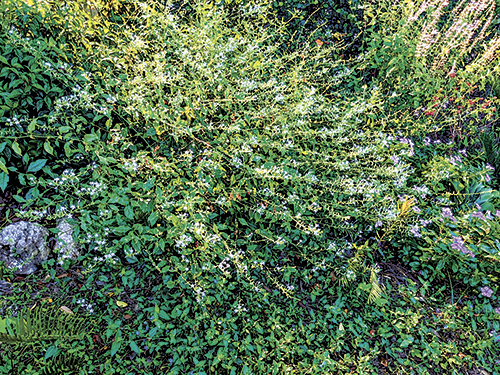
Another option is to plant the Florida native plumbago (Plumbago zeylanica) or wild plumbago. Our cassius blue has spent thousands of years adapting to this particular plant. The native plumbago has smaller, white flowers, which feed a variety of pollinators. The plant itself is also smaller, about 2 feet tall by 4 feet wide. It likes part sun to shade and grows in sand or lime rock along the coast. I have it growing happily under my yaupon holly tree. Leaves remain green without fertilizer. It is found south of Florida throughout the tropics. It is primarily planted to attract butterflies, moths and bees.
If you enjoy searching for the little blue butterflies, you might also enjoy the upcoming Great Southeast Pollinator Census happening Aug. 21 and 22. It is a citizen science project where volunteers select one plant and observe it for just 15 minutes. Fill out the census form and upload it online. To participate, sign up for the newsletter and directions at gsepc.org. To participate with a local group, contact Rotary Park, (239) 549-4606.
Sherie Bleiler volunteers at the Cape Coral Library butterfly garden, Sands Park butterfly garden and is past president of the Garden Club of Cape Coral. Visit gardenclubofcapecoral.com. Like us on Facebook and Instagram.