

Garden Club of Cape Coral | Favorite groundcovers
By SHERIE BLEILER
news@breezenewspapers.com
Groundcovers are a great alternative to grass. They provide variety in texture and form yet still allow us to see clearly over them. If they have flowers for butterflies and berries for birds, so much the better. Plus my favorites do not need mowing, fertilizing or extra water.
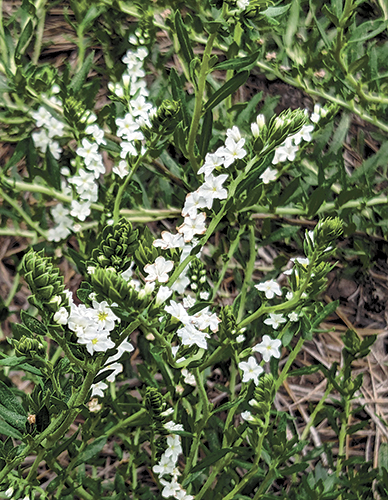
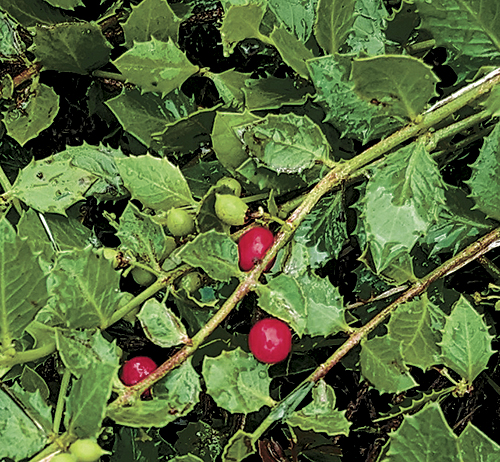
Two that have especially good traits are: Pineland heliotrope (Euploca polyphylla) and quailberry (Crosso-petalum ilicifolium).
I have some quailberry that are over 10 years old. Many shrubs last for years, but this is the only ground cover I know that has staying power. Also called Christmasberry, the leaves look like miniature holly with red berries. For the holidays, the stems may be cut and brought inside for holiday decorations. Birds also enjoy the berries. It is a Florida native that is currently listed as threatened in Florida. What better excuse for locating some of these plants and adding them to our gardens?
It likes to grow in our well drained soil, even though it is full of shells and sand. It is especially drought tolerant, well suited to a rock (limerock) garden. However, organic matter will produce a more beautiful plant. It cannot take salt water or salt spray. Planted a foot from the edge of a flower bed, it makes a well behaved border plant. It only gets 6 inches high, if that, and a couple of feet wide. It is a slow grower, which suits me because it never grows out-of-bounds. It rarely needs trimming. We are at the northern border of its natural range, as it grows well down into the Caribbean.
The second ground cover I adore is Pineland heliotrope. Not a catchy name so I will refer to it as P.H. This is endemic to Florida, which means it grows here and no place else on earth. The leaves resemble pine needles. It stays under a foot tall with many branches spreading across the ground 3+ feet with white flowers at the end of every tip. (There is also a yellow flowered version that grows on Florida’s east coast.) It seems to bloom non-stop, year round, until it wears itself out after about three years. It may be trimmed occasionally to keep it compact. The trimmings may be used to propagate more plants.
This year, after enjoying this plant in my irrigated yard for six years, I started noticing a similar plant in an empty lot. During our extreme drought this spring, in a dry, non-irrigated park, small plants dotted the field, full of blooms. They were smaller, roughly 4 inches high by a foot wide, but they were growing well! (This field gets mowed, too.) This was also P.H. Unlike quailberry, P.H. is not endangered at all. It looks like this plant is as happy growing wild as in our yards.
One secret to the survival of this plant living in a hot, dry environment with blazing sun is that it has C4 photosynthesis. It shares this ability with plants such as maize and sugarcane. The chemical details escape me, but apparently this gives P.H. an efficient way of obtaining carbon dioxide. This helps it minimize water loss through its pores, and use nitrogen more effectively. Probably the best advantage of C4 photosynthesis is being able to convert more of the sun’s energy into carbohydrates without burning up like other plants exposed to blazing sun.
It’s exciting to discover plants that have evolved to fit our environment so perfectly. We have only begun to unlock their secrets. They are beautiful inside and out.
Both plants are readily available from our local native plant nurseries.
Sherie Bleiler volunteers at the Cape Coral Library butterfly garden, Sands Park butterfly garden and is past president of the Garden Club of Cape Coral. Visit gardenclubofcapecoral.com. Like us on Facebook and Instagram.