

Garden Club of Cape Coral | Cardinal air plant
By SHERIE BLEILER
news@breezenewspapers.com
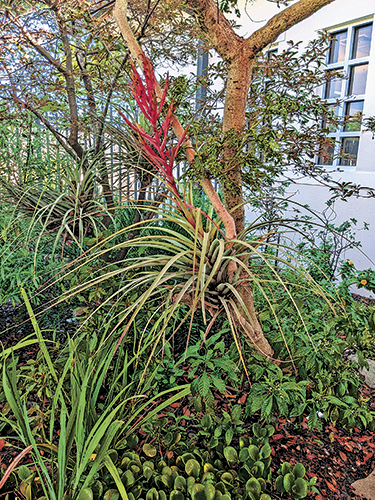
I was admiring the air plants clinging to the branches at the south Cape Coral library butterfly garden. They are blooming now. Rising from the top of the plant is a stiff red stem with several branches on each side. At each tip is a small, purple flower which lasts only a day. This month, a hummingbird was photographed in Estero sipping nectar from one of these flowers! It got me wondering . . .
Air plants – how do they do it?
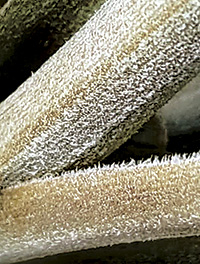
How do they live and grow without their roots in the ground? They have figured out how to live, just hanging on to the branch of a tree. Their roots are wiry strands that stick really well to whatever surface the plant finds itself on. For gathering water, they have leaves coated with scales or disk-shaped leaf hairs called “trichomes.” This gives dry leaves a gray appearance, but when wet, they turn a rich green. They can also gather water in their “tanks.” Each leaf overlaps the next one, forming a hollow down the middle of the plant which can hold and store water. As leaves, dust and other debris collect in the tank and decompose, the airplant absorbs nutrients. Mosquitoes, frogs and others may use this water source also.
Air plants are epiphytes, which means they grow on other plants without taking any nutrients from them. They are not parasites.
The cardinal air plant (Tillandsia fasciculata) is found from south Florida to South America.
It has stiff leaves 12-26 inches long and is usually found in clusters. This is because the parent plant produces “pups,” offshoots from the base of the plant. After a year or two, they become a clump of three or four. At the library, it has also spread its seeds throughout the garden over several years. Now it is on many of the shady tree branches there. It is endangered in Florida, partly due to habitat loss and illegal collecting. However, the primary threat is the Mexican bromeliad weevil that has swept through Florida recently. Weevil larvae eat the leaves at the base of the plant.
Being endangered, it is illegal to harvest these plants out of trees in the wild. However, after a rain storm, you can sometimes find these on the ground from being blown out of the trees. They will die if not rescued. You can bring them home and tie them to a fork of a tree with their base touching the branch. Or you may tie them to a piece of wood and hang them in part shade. They will eventually grow roots to attach themselves. If they are not outside, getting the morning dew, you should spray them daily with water, ideally rain water. Keeping water in the tank is the most important task. If growing it outside, it needs nothing. It can handle the dry season without special care.
As you enjoy your walks outside, look up for these unique plants nestled in the trees. Or visit the south library butterfly garden in the back courtyard. Look to your right and see them in the tall bushes growing along the wall.
Sherie Bleiler volunteers at the Cape Coral Library butterfly garden, Sands Park butterfly garden and is past president of the Garden Club of Cape Coral. Visit gardenclubofcapecoral.com. Like us on Facebook and Instagram.