

Garden Club of Cape Coral | Spring planting tips
By CAROLE KERNS
news@breezenewspapers,com
Spring is fleeting in Southwest Florida. As the weather warms quickly and our gardens brighten with flowers, savvy gardeners prepare their gardens for the heat and humidity of summer.
April is still a good time to plant heat-tolerant annuals. Zinnia (Zinnia elegans), melampodium (Melampodium divaricartum) and brightly colored gazania (Gazania rigens) establish from seed in sunny areas of your garden. Crossandra (Crossandra infundibuliformis) thrives in indirect sunlight, adding color to shady areas.
Shade tolerant caladiums (Caladium) grow from tubers that sprout in a few weeks. These stunning plants produce large, colorful leaves. Some varieties may produce leaves up to 23 inches long under good conditions. Caladiums thrive in Southwest Florida from March through September.
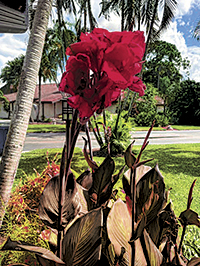
Spring is also a good time to plant cannas (Canna x generalis). Cannas grow from underground stem modifications, called rhizomes, that have nodes which give rise to roots and shoots. The shoots grow upward, and the rhizome extends horizontally under the soil. Plant the rhizomes 4 to 6 inches deep and 2 feet apart for tall varieties or 1 foot apart for the medium to dwarf types. Cannas prefer sunny locations where the soil drains well. While these magnificent flowers are in bloom, expect pollinators to visit.
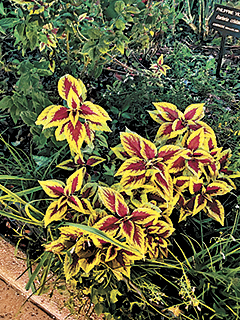
As the weather continues to warm, other heat tolerant annuals, such as coleus (Plectranthus scutellaroides), vinca (Catharanthus roseus) and portulaca (Portulaca oleracea), add volume and color to the summer garden. Coleus cultivars come in vibrant leaf colors and intricate patterns. Portulaca grows in a low-trailing habit forming an attractive ground cover. Various color varieties produce flowers that close at night and reopen the next morning with exposure to direct sunlight. Vincas flourish in full sun or part shade and flower continually with regular watering.
Consider adding herbs to your garden. Basil (Ocimum basilicum), cilantro (Coriandrum sativum) and cumin (Cuminum cyminum L.) need full sun, whereas mint (Mentha) prefers partial shade. Most herbs grow well in containers, adding depth to your landscape. As the weather heats up, add more summer herbs, such as summer savory (Satureja hortensis) and rosemary (Salvia rosmarinus). For a tropical addition, ginger (Zingiber officinale) offers lush greenery in areas with moist soil and partial shade. What better way to escape the heat than to cut fresh herbs from your garden and to get creative in your air-conditioned kitchen!
Since insects become more active in warm weather, monitor your landscape plants for pests. Aphids love soft, lush, new growth. They are small, 1/16 to 1/8 inch-long, pear-shaped, soft-bodied insects, which vary in color and can be winged or wingless. Other insects of concern include scales, mealybugs and whiteflies. These insects feed by sucking sap from leaves and stems.
Identifying an insect attack early allows you to use non-toxic ways to control them. A strong blast of water from a garden hose may dislodge some and reduce their numbers. Manually rubbing or scraping the pests from leaves and stems as well as removing infested leaves can limit their damage. Applying horticultural oils and insecticidal soaps to the infected leaves and stems suffocates the insects. Finally, increasing natural predators by purchasing lady bugs, lacewings and/or parasitic wasps may control the pests if the beneficial insects remain where they are introduced. These measures manage insect pests while diminishing the impact on beneficial insects. Conserving beneficial insects, including the praying mantis, ground beetles, soldier beetles, lady bugs, assassin bugs, predatory wasps, robber flies and hoverflies, is crucial for a healthy home landscape. More than 97% of the known insect species in the world are beneficial
To help you choose the ‘Right Plant for the Right Place” in your landscape, UF/IFAS Extension has developed a plant guide app: https://ffl.ifas.ufl.edu/resources/apps/plant-guide/ With careful planning, the time you invest in your garden in the spring will provide a satisfying return in flowers, full foliage, pollinator activity and aromatic herbs.
Carole Kerns is a Master Gardener Volunteer with UF/IFAS Lee County Extension and a volunteer at the Berne Davis Botanical Garden.