

Garden Club of Cape Coral | Building A Florida Friendly Garden, Part 3
By MERYL O’ROURKE
news@breezenewspapers.com
Hello, fellow gardener, welcome back! This week, we’ll work our way down the north side of my front lawn. The area being planted is approximately 35 feet long, so there’s plenty of room to put plants in groupings.
As this is the only area without overhead power lines, I have the freedom to use plantings that will have some height. My choice is black bamboo, in particular timor black (Bambusa Lako), which is a clumping bamboo which is native to Indonesia. Bamboo comes in two types – clumping or sympodial, and running or monopodial. The clumping will grow in tight, slow spreading clusters while the running spreads rapidly via underground rhizomes. I prefer the clumping, as I can control it easily to keep it contained within my garden and not have it invading my neighbors. It’s quite lovely, as the culms (stems) start out green prior to turning black. I’ll be planting five separate areas of bamboo along the 35-foot line between my neighbor’s property and mine.
One of the few plants that I did not remove from my yard when I was cleaning out old plants was a very large frangipani (plumeria). Native to the Caribbean, they come in a multitude of colors. I’m a fan of their beautiful scents! You might recognize the flowers as those found in Hawaiian leis. During the winter months, they drop their leaves and have a skeletal look to them. Easily propagated by cuttings, I’ve cut six very large pieces off the parent tree, allowed the ends to harden, and “planted” them in blue Lowe’s buckets with soil. They’ll be planted in the open spaces between the bamboo, about 5 feet in front of the space. That way, I can get behind them to do any pruning necessary.
Keeping in mind the skeletal look of the plumeria in the winter, I’m adding pink muhly grass (Muhlenbergia Capillaris) around the base to soften the starkness of those empty branches. The grass will also complement the fullness of the leaves in the summer.
As there are literally no trees on the front of my property, there’s also no shade, meaning no place to put some interesting shade plants. Hence the clumping bamboo. As well as acting as a divider from my neighbor, it will provide the shade I need for the last plant I will add to this first round of planting in this area.
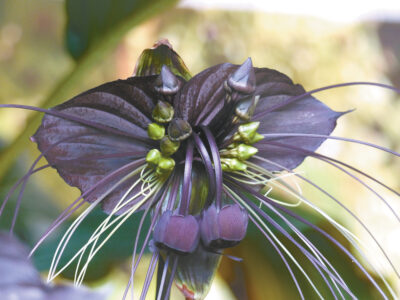
Native to southern parts of Asia, bat flower (Tacca Chantrieri) has shiny, bright green leaves. It blooms on a stem from the center of the plant, with a cluster of dark purple flowers in the center. Above these flowers are two bracts (leaves that resemble flower petals) that look like bat wings. Numerous threadlike bracteoles hang from the flowers resembling 8 to 10-inch-long whiskers. The bloom of the Chantrieri is so dark, it appears black! As my soil is not exactly what this plant would prefer, I plan to put several of them in pots with the proper mix of 50% pine bark, 40% peat and 10% sand. As this plant likes wet feet, I’ll keep saucers underneath the pot and give it some soluble orchid fertilizer bi-weekly.
I’ll have these plantings settle in for several seasons, to make sure they’re happy in their new home. The next area to tackle will be removing an old brick walkway and installing one that is more modern. Thank you for coming on this journey with me!
Meryl O’Rourke, a UF/IFAS Master Gardener, volunteers at the Berne Davis Botanical Garden and the Goodwill Pathways to Opportunity Food Garden.