

Garden Club of Cape Coral | Landscaping with low maintenance plants
By CAROLE KERNS
news@breezenewspapers.com
For many of us, January through April are busy months in Southwest Florida. The area comes alive with art exhibits, theater productions and nature walks, to name a few. We enjoy having time to visit with friends and family who travel down to escape the cold, northern temperatures. We want to have lovely gardens where we can relax with our guests without having to excuse ourselves to care for our landscape. One solution is to plan an easy-care landscape with low maintenance plants.
The term “low maintenance” refers to plants which do not need frequent care, such as pruning, watering or spraying to remain healthy. These plants have low fertilizer requirements, few problems with disease or pests, and have adapted to our hot, wet summers and our dry winters. Additionally, the plants should not be listed as invasive by the Florida Exotic Pest Plant Council or the UF/IFAS Assessment of Nonnative Plants in Florida’s Natural Areas. It is of utmost importance to select the “right plant for the right place.” When doing so, try to group plants together according to their needs which include light, moisture and temperature. Remember when selecting plants that common names are often misleading, and sometimes more than one plant species may share the same or similar common name. When possible, it is better to refer to scientific names when researching plants for your landscape.
Annual plants complete their life cycle in one growing season. Because of Florida’s warm climate, some annuals last more than one year and continue to bloom. Perennials live for three or more years and vary in their life spans. Some annuals behave like perennials and appear to return year after year. A new generation of plants has grown from the seeds dropped by the mother plant, a process referred to as self-seeding or reseeding. Zinnias (Zinnia elegans) are an example of self-seeders.
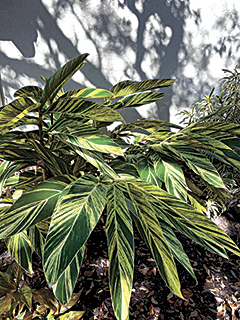
When planning a garden, interspersing brightly colored plants with green leafy plantings defines the area with a contrast of colors. Crotons (Codiaeum variegatum) with their brilliantly colored leaves, feature many leaf types and sizes, from swirly ribbons to wide, flat leaves. This perennial shrub has the best color in bright, indirect light and does well in fertile, well-drained moist soil. Coleus (Plectranthus scutellarioides) is a heat tolerant, durable annual that has very few disease or insect problems. It is known for its colorful foliage and can be paired with the selloum philodendrum (Thaumatophyllum bipinnatifidum), or the variegated ginger (Alpinia zerumbet “Variegata”) for a dramatic effect. The selloum philodendron grows quite well in full sun or partial shade and needs some room to spread. It can also be used in large containers which look attractive on the patio or at poolside. The variegated ginger is a striking foliage plant with its large yellow and green striped leaves and its clusters of fragrant white flowers blooming from summer to late fall. It is an herbaceous perennial which needs room to spread and does best in partial shade.
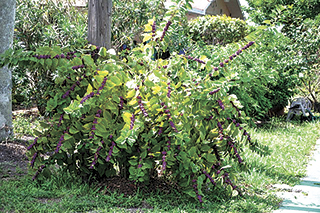
Low maintenance pollinator plants can add beauty and excitement to the garden by attracting bees, butterflies and birds. These include the butterfly weed (Asclepias tuberosa), white wild indigo (Baptista alba), American beautyberry (Callicerpa americana), button bush (Aphalanthus accidentatis), Indian blanket (Gaillardia pulchella), beach sunflower (Helianthus debilis) and scarlet sage (Salvia coccinea). Many pollinator plants need full sun and well-drained soil. The exceptions are the scarlet sage, the American beautyberry, and the button bush which prefer moist soil.
Ornamental grasses can provide texture and variety to offset your flowering plants. They come in multiple shapes, heights and foliage colors. Grasses that are easy to care for include pampas grass (Cortaderia Sloane), lemongrass (Cymbopogon citratus, Stapf), pink muhly grass (Muhlenbergia capillaris) and palm grass (Setaria palmifolia). It is recommended to plant ornamental grasses in the spring, but container-grown grasses can be planted in all seasons. Most grasses can benefit from cutting back, usually before new growth begins in the spring. Grasses grow best in three to five hours of direct sun each day. In the shade, grasses may not bloom and often become limp.
The plants listed here were taken from a list of low-maintenance plants compiled by UF/IFAS. For more information on low-maintenance plants, go to sfyl.ifas.ufl.edu.
To conclude, why not join us at our annual fundraising event – March in the Park, which will take place at Rotary Park, Rose Garden Road, Cape Coral (at the southern end of Pelican Boulevard). This fun event benefits our Marty Ward Merit Awards which gives annual monetary awards to students at local high schools.
There will be lots of vendors, music and food – and, of course, our own very popular plant booth where you can purchase plants grown by our members. You know that they are plants that will thrive in this area.
We will also have an interesting thrift booth selling garden tools, garden art and any other garden-related item that may have been donated. We also have a free Kids Booth for children, where your kids can do a craft, have their face painted and other fun things to do. So come along and support us – 9 a.m. to 3 p.m., March 14, at Rotary Park.
Carole Kerns is a Master Gardener Volunteer with UF/IFAS Lee County Extension and a volunteer at the Berne Davis Botanical Garden.
Visit gardenclubofcapecoral.com. Like us on Facebook and Instagram.