

Garden Club of Cape Coral | Common Florida weeds – part 2
By CATHY DUNN
news@breezenewspapers.com
Last month we learned about two common Florida weeds – artillery weed and creeping woodsorrel. This month we’ll explore two more pesky weeds, or “plants that are out of place” – American black nightshade and dollarweed. Weeds are not only problematic because they reduce the aesthetics of our gardens, but they compete with other plants for light, nutrients, space and water. And they can also be invasive if we don’t control them adequately.
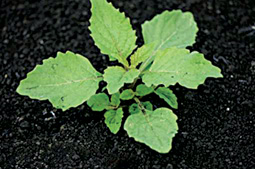
American black nightshade (Solanum americanum) is a toxic annual weed that is found throughout Florida, especially in disturbed areas, agricultural fields and landscapes. This weed is an herbaceous plant with an upright growth habit and can reach a height of 3-4 feet. It has small white bell-shaped flowers, and glossy green berries that turn shiny black at maturity. American black nightshade is especially troublesome because it will thrive in almost any conditions — sun or partial shade, and in moist or dry soils.
The plant is potentially toxic and poses risks to humans and livestock. The unripe green berries present the greatest toxicity hazard as they contain solanine, a toxic glycoalkaloid, but all vegetative parts of the plant can poison livestock. Ingestion can cause gastrointestinal issues, convulsions and hallucinations. Because of these properties, American black nightshade is considered a dangerous weed in pastures.
The plants are prolific seed producers with up to 110 seeds produced per berry. This year I have encountered this weed popping up in my gardens and it grows rapidly and spreads freely. I have been diligently trying to pull the immature plants before they can mature and spread more!
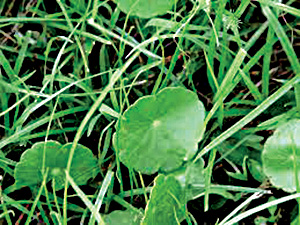
Dollarweed (Hydrocotyle spp) is one of the most common weeds found in Florida lawns. Also known as pennywort, dollarweed receives its name from its round leaves that can grow to the size of a silver dollar. This moisture-loving, creeping plant grows low to the ground with one round leaf per stalk and will thrive in sunny or shady areas. The plant is easy to spot because the fleshy leaves resemble lily pads and measure 1-2 inches in diameter. Dollarweed is very resilient because it can reproduce through seed, rhizomes and tubers. If you see dollarweed in your lawn, it is an indication that you have excessive moisture in the area.
While dollarweed is often found in low lying areas with poor drainage, its presence in well-drained soil is usually an indication of overirrigation. Because the plant spreads through rhizomes, if you hand pull this weed make sure you remove the white rhizomes as well as the leaves.
You can find photo identification guides and videos of common Florida weeds just by googling “Weeds UF/IFAS” (University of Florida/Institute of Food and Agricultural Sciences).
Next month we’ll learn about dayflower and hairy bittercress, two more problematic weeds that you have no doubt encountered in your gardens. The final article in this series will detail basic weed prevention and management.
Please plan to join us at our annual Fundraising event – March in the Park, which will take place at Rotary Park, Rose Garden Road, Cape Coral (at the southern end of Pelican Boulevard). This fun event benefits our Marty Ward Merit Awards which provide annual scholarships to students at local Cape Coral high schools. There will be lots of vendors, music, and food – and our own very popular plant booth where you can purchase plants grown by our members that will thrive in this area. We also feature an interesting thrift booth selling garden tools, garden art and other garden-related items. Your kids can make a craft, have their face painted and participate in other fun activities at our free Kids Booth. We hope you will support us on Saturday, March 14, 9 a.m. to 3 p.m., at Rotary Park in Cape Coral.
Cathy Dunn is a Lee County Master Gardener Volunteer, Garden Club of Cape Coral Member and president of the James E. Hendry Hibiscus Chapter.
Visit gardenclubofcapecoral.com. Like us on Facebook and Instagram.