

Zebra longwing butterfly
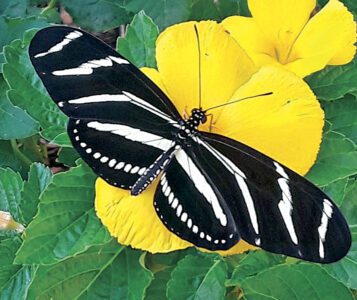
The zebra longwing is our official state butterfly and usually quite common around town. Yet they have been strangely absent from Cape Coral since Hurricane Ian. Let’s help them make a comeback!
Zebras are 3-4 inches wide and black with creamy white stripes. They are often found gently fluttering in the shade. At sunset, they gather and roost in groups and disperse at first light. To feed, they uncurl their long tongue, or proboscis, which works like a straw to sip nectar from flowers. Unlike most butterflies, they can also digest pollen, which allows them to live up to six months, instead of a couple of weeks.
Besides searching for food, zebra’s spend their lives looking for mates and finding their favorite plant, the passion vine, to lay their eggs. Butterflies are very particular about the plants on which they lay their eggs. There are several varieties of passiflora that they will use. Maypop (passiflora incarnata), with large purple flowers, and corkystem (passiflora suberosa) are both passion vines native to Florida. Other non-native vines are blue, white, yellow and purple. “Lady Margaret,” with a striking deep red flower, is fine. However, coccinia or other red passion vines are deadly to the zebra caterpillars. Passion vines prefer sun and a tall trellis although corkystem will grow in shade along the ground if it has no support. Maypop sends underground runners and may pop up far from the vine, which are objectionable to some people.
Zebra butterflies lay multiple tiny cream colored eggs on the tips of new growth or on the vine tendrils.
Caterpillars are white with black hairs which look like spikes, but are really soft.
By eating the passion vine, the caterpillar eats a toxin which makes him taste bad to birds. His bold white and black coloring is a sign to predators to stay away. Yet wasps do not heed the warning.
Eggs and caterpillars make easy to digest food for wasp larvae. Other predators are lizards, our local anoles. Ants also patrol passion vines. At the base of each leaf, the vine exudes a nutritious nectar which the ants eat. In return, the ants patrol the vines and protect them from those that might eat it, including zebra caterpillars. Few zebra eggs make it to a mature butterfly.
After the caterpillars munch away for 10-14 days, they attach their back end to the stem, hang upside down and shed their skin for the last time. As their skin falls off, a brown leaf shape remains as the chrysalis. After 7-10 days, the skin breaks open and a butterfly emerges. The transformation is miraculous!
The Tom Allen Butterfly house at Rotary Park is raising zebra butterflies and hopes to help populate the Cape with zebra butterflies once again. The open butterfly garden at the south Cape Coral Library, 921 S.W. 39th Terrace, is also releasing zebra butterflies into this garden, where the Garden Club of Cape Coral has planted many passion vines. You can help too! Plant passion vine plants at your house and they will come! You can find them at several local nurseries: All Native, Danny Yates, Riverland and Thrifty Garden next to Butterfly Estates. Be careful not to get the ones with bright red flowers as they will be toxic and kill the caterpillars.
Help the zebra butterfly become a frequent visitor to our yards and a pollinator of our flowers once again! Please plant passion vines and help beautify the Cape with our state butterfly!
Sherie Bleiler is chairperson, library butterfly garden, and Garden Club of Cape Coral member.
To reach SHERIE BLEILER, please email news@breezenewspapers.com