

Garden Club of Cape Coral | Preventing, treating Florida Weeds
In my previous three articles I reviewed the nature of weeds, or “plants that are out of place.” Weeds not only compete with the plants we have installed in our landscape for light, food, space and water; they can also be invasive or “noxious” (poisonous or with harmful thorns and spines). I provided details on six of the most common Florida weeds: American black nightshade, artillery weed, bittercress, creeping woodsorrel (Oxalis corniculata) dayflower and dollarweed. In this article I will discuss various methods to treat and eliminate these pesky weeds!
Preventing weeds is a good starting point for keeping your landscape weed-free. Since light stimulates the germination of many weed species, soil disturbance is a sure way to get weeds off to a quick start. Applying sheets of newspaper or landscape fabric can help deter weeds, but this requires work well in advance of your planting. Mulch will help obstruct light which makes it difficult for weeds to germinate, but sometimes mulch can introduce weed seeds into your landscape! Cleaning your mower after use will help reduce equipment contamination, but if you have a lawn service you don’t have any control over this potential source of weeds. You should also check plant containers for weeds when you bring them home from the nursery; weeds are unfortunately common “hitchhikers” on pots and soil.
Using appropriate irrigation can help reduce weed growth; many of the common weeds I discussed in earlier articles require high levels of soil moisture to germinate. Carefully controlling your irrigation, particularly in open or bare areas, can assist in reducing weed germination.
Careful fertilization is also recommended as a method of discouraging weeds; most established shrubs and trees require little fertilization so excess fertilizer can actually encourage weed growth! If you decide to use a “weed and feed” combination of herbicides and fertilizer, please be aware that such products are intended for use on turf. These products should not be applied near ornamentals or in planting beds.
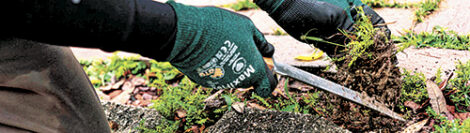
My preferred method of eliminating weeds is “mechanical removal” or hand-pulling. There is something extremely satisfying about removing these nasty weeds that somehow still manage to overcome my creaky knees!
I think that the key to successful hand weeding is to use the proper tools. I have used a Japanese weeding hoe for years; it has a triangular wedge-shaped head with a sharp point and a sharp blade along the bottom of the head. I find it ideal for removing single weeds with the sharp point or uprooting a row of weeds with the blade. Merely pulling weeds by hand often leaves the roots behind, and within a week you’ll have the weed back stronger than ever.
A final and last resort for eliminating weeds is using herbicides. Herbicides are chemicals that prevent or kill weeds upon application. If you choose to use herbicides, you must carefully follow instructions to ensure success.
There are two types of herbicides: pre-emergence and post emergence. Pre-emergence herbicides must be activated by irrigation or rainfall, generally .25 inches or more within three days to a week after application, to work. These herbicides should not be applied during new growth flushes or budding, and plants should be thoroughly watered prior to application. Post emergence herbicides should be applied directly to the weed, using care not to contact ornamental plants. It is also critical that the application is accurately measured since ornamental plants can become injured if higher than recommended doses are applied in surrounding areas. One of the greatest dangers of using herbicides is “drift” or the movement of herbicidal spray due to wind. Systemic herbicides (chemical insecticides that are absorbed through the plants’ roots or leaves and distributed throughout the vascular system) should be used cautiously around plants that sucker, such as crape myrtle, as some ornamentals may not recover from contact.
The use of any type of chemicals in the garden should be carefully considered and closely monitored. UF/IFAS offers extensive information on weed management and control, and I encourage all gardeners to use this incredible resource. Simply type your question into Google and include “UF/IFAS” in the search term for the best available information for Florida-specific gardening.
Weeds are an aesthetic nuisance that can divert precious environmental resources away from the ornamental plants that we want to thrive in our landscapes. I am often guilty of waiting until I have a huge weeding project to conquer – but what great satisfaction it brings when I can attack those weeds and enjoy a clean landscape! I hope that you have learned how to identify some of the most common Florida weeds, and that you are now inspired to prevent and remove these intruders! With the help of UF/IFAS you can develop a plan to not only prevent but eradicate these unwelcome weeds.
Cathy Dunn is a Lee County Master Gardener Volunteer, Garden Club of Cape Coral member and past president of the James E. Hendry Hibiscus Chapter.
To reach CATHY DUNN, please email news@breezenewspapers.com