

Buzz word: Control | Treatment underway as season brings hordes of hungry mosquitoes
It’s been an unorthodox season for the Lee County Mosquito Control District.
Mother Nature hasn’t brought consistent rain until recently, and then, a salt marsh mosquito issue coming out of Estero Bay brought large numbers of insects.
“Typically we treat that, and that state was requiring an interlocal agreement with Fort Myers Beach Mosquito Control,” said LCMCD spokesperson Jenifer McBride. “So until we could get that signed and go in and treat, because they’re not able to treat that area, we were seeing a lot of the salt marsh mosquitoes, especially around the coastal area.”
McBride said as the two districts came to an agreement, salt marsh mosquitoes became an issue and were impacting citizens in Lee County, including those in south Cape Coral.
“The salt marsh mosquito is really why we have all of the aerial equipment we do,” she said. “The good news is, now that we’ve gotten the rain, the salt marsh mosquito actually gets better, because they lay their eggs in the moist soil instead of the water. So once we get the areas flooded, the salt marsh mosquitoes are not as much of a problem. But now, we’re starting to see the inland mosquitoes.”
Another issue that has not yet, and hopefully won’t, plague Lee County is the presence of the Dengue fever in the state. LCMCD personnel were in Hillsborough County on Wednesday assisting with the outbreak of virus in the Tampa area. McBride said there have been 170 cases in Hillsborough County thus far, a number that hasn’t been seen in 50 years. There has been one death.
“We’ve been on extra alert making sure we’re still monitoring that backyard mosquito that lives in everybody’s backyard, and making sure that we don’t have those viruses in Lee County,” McBride said. “It’s just been a very unusual summer.
Thus far, Lee County has only seen “travelers” cases of Dengue, meaning an individual went somewhere, came back, and experienced symptoms. McBride said many reports have been of people that have gone to places such as Puerto Rico or Cuba.
The health department does notify LCMCD of these cases, and then the district goes right into to trapping to see if mosquitoes in the county are carrying the virus.
“We do extra layers of treatment just to try to get that mosquito out and break the cycle before it becomes localized,” she said. “There have been no local cases like we’re seeing in Hillsborough. But, we’re pretty lucky. We have all of the tools to do disease monitoring before it gets to humans, which a lot of the counties don’t have. We’re being extra vigilant.”
LCMCD methods of mosquito control includes four main strategies: prevention, source reduction, larviciding, and adulticiding. Prevention and source reduction — like removing standing water — are the most effective. Larviciding targets immature mosquitoes in water, while adulticiding is a last resort used at night to minimize harm to other insects.
LCMCD officials state that larviciding targets mosquitoes in their larval stage while they’re still in water, preventing them from becoming flying, biting adults. Adulticiding targets mosquitoes that are active and flying and is typically done in the early evening when mosquito activity increases and populations exceed thresholds set by the state.
McBride said there is a lot of science that goes into mosquito control, it’s not just going around dumping chemicals in places that need treatment.
“That’s so far from the truth,” she said. “We actually have very few chemicals to treat with, rightfully so. We’re highly regulated by the EPA and have to be safe.
“We set traps. We’re out every day, boots on the ground. We’re checking the water, doing adult counts. We look at our citizens’ reports to see where we are getting calls from. We’re a countywide service. We have to meet a threshold in order to do any kind of treatment. We want to make sure we are protecting the environment. We’re not a pesticide company. We’re protecting public health for the county.”
The county also uses sentinel chickens, with 18 coops around the area, to test their blood for any potential virus that mosquitoes may be carrying.
As for the presence of salt water marsh mosquitoes, residents may not realize the vast amount of land in the county that falls under that designation. Lee County is one of the most prolific mosquito breeding habitats in the world due to its 56,000 acres of salt marsh. The combination of a vast coastline, flat terrain and subtropical climate supports year-round salt marsh mosquito production, LCMCD officials state, adding that on Sanibel Island, egg densities have been recorded as high as 45,000 per square foot.
“(Salt water marsh mosquitoes) can travel about 20 miles away from where it’s breeding,” McBride said. “And what we’ve done is we’ve developed right to the edge of the salt marsh area, so it’s still affecting a good percentage of our residents, especially in the coastal areas.”
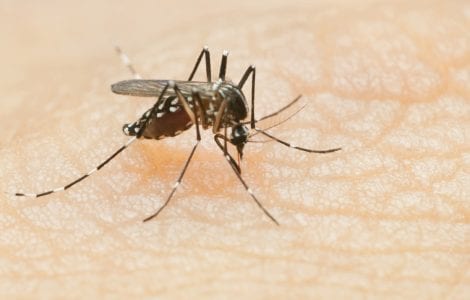
What the majority of Lee County residents interact with are Aedes aegypti mosquitoes, which are backyard mosquitoes and the ones that carry Dengue.
“With Aedes aegypti, the most important thing to know about it is the relationship with humans that most don’t realize,” McBride said. “It is going to breed in your backyard. If you’re getting bit by Aedes aegypti, you’re probably the breeder of it in your own backyard.”
According to LCMCD officials, to reduce mosquitoes on your property, remove standing water where mosquitoes lay eggs, such as in buckets, birdbaths, gutters, old tires, and bromeliads. Trim grass and shrubs to eliminate resting spots. Use window and door screens, and place fans in outdoor areas to deter them. EPA-approved repellents can also help protect you from bites.
“When we’re talking about (mosquitoes that carry disease), we’re talking about mosquitoes that like to be around people such as Aedes aegypti,” McBride said. “The rest of them that we control, they’re not necessarily near people. They’re not picky about their blood meal. Aedes aegypti are picky. They like human blood.”
McBride said there are 54 species of mosquitoes in Lee County, though the district only controls 10 of them, “because the rest of them, they don’t take human blood … We control and not eradicate.”
LCMCD officials state both adults and larvae serve as a food source for birds, bats, amphibians and aquatic predators. They also help pollinate plants while feeding on nectar. While they’re often seen as pests, mosquitoes are part of a larger ecosystem that supports biodiversity.
For more information on LCMCD or to make a report, visit leecountymcdfl.gov.
To reach CJ HADDAD, please email cjhaddad@breezenewspapers.com