

DeSantis calls for special session on constitutional amendment to increase homestead exemption on property taxes
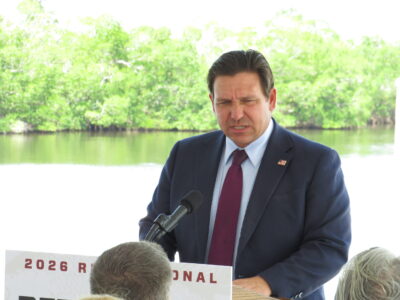
Gov. Ron DeSantis announced he is calling for a special session of the Florida Legislature during the week of June 1 to consider a constitutional amendment that would raise the homestead exemption for property taxes for up to $250,000 of the property’s assessed value.
The current homestead property tax exemption is up to $50,000 for homeowners.
DeSantis called his proposal the “Save Our Homes from Excessive Property Taxes plan” to eliminate taxes on homesteads, in a statement sent out by his press office. “Property tax revenue collected by local governments has nearly doubled in the past seven years and is expected to reach an astounding $83 billion by 2032. Florida homeowners need relief. Now is the time to stand up for taxpayers, enact a historic reform, and save the home of every Floridian.”
The Lee County Board of County Commissioners voted on Tuesday to oppose the homestead property tax exemption proposal of Gov. Ron DeSantis that is currently in front of the state legislature, unless the revenue losses for local governments can be replaced with “stable, recurring replacement funding sources.”
The county projects that the bill could cause a property tax revenue loss of $129.7 million in next year’s budget and a $240.8 million loss in the 2028-29 budget.
In his announcement DeSantis cited an increase in property tax revenue collected by local governments over the past seven years (from $32 billion to $60 billion). Much of that increase is due to new homes and businesses in Florida as the state’s population has increased.
As proposed by DeSantis, the new amendment to the Constitution would exemot the first $250,000 of a homestead’s value from taxation and requiring, through law, a schedule for full elimination.
The proposal would require local governments to use remaining property taxes solely for core public needs including public safety, education and schools, infrastructure, and natural resources.
Desantis also wants to place limits on future property tax assessments on businesses.
The Governor also wants homeowners to prove residency of up to five years prior to receiving the property tax exemption.
Requires any person who establishes Florida residency after Jan.1, 2027, to maintain Florida residency for up to five years prior to receiving the increased homestead exemption.
The proposal is receiving backlash from local governments whose services could face massive reductions if the proposal is approved by voters.
Fort Myers Beach Manager Will McKannay said the proposed legislation could have a significant impact on the town’s budget. “The proposed changes to the homestead exemption could significantly reduce a town’s most stable and locally controlled revenue source,” McKannay said. “Because property taxes fund essential services like public safety, infrastructure, cultural programs, and parks and recreation, any major shift without a sustainable replacement could affect service levels and long-term financial stability. I look forward to reviewing the details and working with state leaders to ensure we can continue meeting the needs of our residents.”
Fort Myers Beach Mayor Dan Allers said “it is still too early to fully comment on the Governor’s proposal regarding property tax legislation. There are still many details that need to be discussed and understood before anyone can accurately assess the long-term impacts on local governments and taxpayers alike. I believe we will have a much clearer picture after the upcoming special session and once more specifics of the proposal and any accompanying legislation are released and debated.”
State Senator Jonathan Martin, whose district includes Fort Myers Beach and most of Lee County, did not respond to a message seeking comment. Rep. Adam Botana, whose district covers Fort Myers Beach, Bonita Springs, Estero, and Sanibel, also did not respond to a request for comment.
State Senator Kathleen Passidomo, whose district encompasses part of Lee County and most of Collier County, referred to a statement by State Senate President Ben Albritton in support of the measure.
Albritton, in a memorandum issued Wednesday, said “In my view, the proposal the Governor explained today does that. I can’t think of a more meaningful way to celebrate America’s 250 then the passage of $250,000 in tax relief for every Florida homeowner. I believe this amendment will provide meaningful relief for Florida families, while protecting businesses from extreme tax increases and safeguarding local funding for public safety, education and our clean water infrastructure.”
Albritton, whose district covers a portion of northern Lee County and most of Charlotte County, commended DeSantis “for starting what has been a robust discussion on property tax relief throughout our state and to our partners in the Florida House for putting forward several meaningful and thoughtful proposals,” Albritton said. Albritton noted that any bill passed by the state legislature will require voter approval.
“At the grocery store, gas station, church on Sundays, and everywhere in between, Floridians I speak with are clear in their support for reducing property taxes,” Albritton said. “I suspect we are all hearing the same things in our home communities. We trust our constituents and they deserve a chance to change the system and decide for themselves what role property taxes should have in our state.”
State Rep. Tiffany Esposito and Rep. Mike Giallombardo, whose districts cover parts of Lee County, also did not respond to emails seeking comment.
DeSantis said he wants to establishes a trust fund to provide grants to local governments to assist with the continuation of core local services.
The proposed amendment to the Constitution, if ratified by the Republican-controlled state legislature, would need to go in front of state voters for a referendum for their approval.
Under Florida’s Constitution, any Constitutional amendment must be approved by 60% of the voters to become law.