

Florida Education Association sues over state’s funding of schools
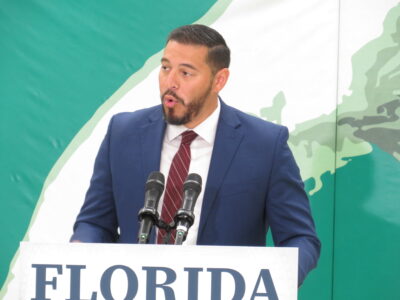
Just days after Gov. Ron DeSantis touched down at Fort Myers High School to rail against teachers unions with Florida Commissioner of Education Anastasios Kamoutsas, the Florida Education Association sued Kamoutsas and the Florida State Board of Education for failing to adequately fund the state’s public schools.
The lawsuit alleges that the funding formula that gives state funds to charter schools and vouchers for private schools has diverted funds from public schools. The lawsuit alleges that the disparity in funding violates the state constitution by creating and funding a “non-uniform system of publicly financed education.”
The Florida Education Association filed the lawsuit on May 5, four days after the appearance by DeSantis, in which he went on a blistering attack on school unions while joined by Kamoutsas, state legislators, school board members, and Lee County Superintendent of Schools Dr. Denise Carlin.
Florida Education Association President Andrew Spar criticized the attack for “literally bringing politics into the schools” while accusing school teacher unions of being politicized.
“They literally came into a school for a political sideshow,” Spar said. “They didn’t come in to talk to students and focus on students, they didn’t go in on the eve of appreciation week and say ‘hey, we are here to let you know how grateful we are for the work you do for teacher appreciation week,’ they came in to serve a political purpose, for the governor to sign a bill that is meant to take the voice away from educators.”
The bills regulate teacher unions and prevent teacher unions from being able to negotiate benefits for teachers who elect to teach at underperforming schools.
Spar has been following the discussion involving pending budget cuts at the School District of Lee County.
“She is arguably saying this is about tightening the belt but Florida is near the bottom in funding for our public schools, 41st in the nation out of 50 states.”
Spar said he believes the school district is running into the same funding issues that other schools are experiencing in the state due to the outflow of funds from the school district to charter schools and private schools.
“What we continue to see happen is a divergence of dollars to charter schools and vouchers that are unaccountable,” he said.
Spar said the funds going to charter schools and the vouchers for private schools leaves an unaccountable system where they don’t report back to the public on the use of their funds.
Spar said he listened to the press conference that Carlin recently had and said “numbers are not adding up right now.” He noted that Carlin was asked about the decline in enrollment but how that only made up a small percentage of the overall budget shortfall the district has. In other districts, where enrollment has gone up, they too are facing budget issues, Spar said. “We have some major school funding issues in the state of Florida.”
Spar said Florida isn’t fully funding public school education, and is “draining public dollars for these other programs. Spar said the diversion of funds to charter schools and for private schools, and homeschooling, has led to an income drain for public schools. The association alleges that the state now directs $4.9 billion each in public education funds to private schools and charter schools.
“By 2025, about 24% of state education funding is going to scholarship programs,” the lawsuit states.
More than 524,000 students in Florida receive scholarships, representing about one in four students in the state’s funding system, the lawsuit alleges. About 69% of students receiving public funds for scholarships were already attending private schools before the state began providing school vouchers to families two years ago, the suit contends.
Another issue for the association aside from the funding, is the lower standards for charter schools, private schools and homeschooling.
While public schools are required to teach the history of the U.S. including topics such as the U.S. Constitution, Declaration of Independence, civil government, federal and state government, the history of African Americans, as well as the history of the Holocaust, private schools and homeschools are not required to teach these subjects, the lawsuit states. Charter schools also have differing standards on how much of those subjects need to be taught to students.
“They have less requirements,” Spar said. He said homeschooling requirements are far lower than all of the other types of schooling.
“These dollars are going to programs that are not being held to any sense of standard and it is happening at the expense of our public schools. They don’t have the same teacher certification requirements, they don’t have the same requirements for curriculum, or safety and transparency,” Spar said.
Spar said there are more than 1,400 pages of requirements for public schools in Florida, but a much smaller fraction for charter schools and private schools, and about 20 pages for homeschooling and scholarship-supported private schools, he said.
“That is not a uniform system,” the lawsuit states. “It is a system that is inconsistent and unequal, and one that inevitably leads to a lower and uneven quality of education across the state.”
Spar said there is also inadequate oversight of state funds flowing into homeschooling vouchers. He referred to a recent state auditor’s report that called for further transparency of how state funds are used for the homeschooling vouchers.
The lawsuit states that “the State has built a system where publicly funded schools operate under very different rules. Schools receiving taxpayer dollars are no longer held to the same standards, the same oversight, or the same level of accountability. As a result, students are not being served equally.”
The lawsuit alleges that the Florida Constitution has been violated through an unfair system. The lawsuit quotes Article IX of the Florida Constitution, which provides that “adequate provision shall be made by law for a uniform, efficient, safe, secure and high quality system of free public schools.”
Florida Department of Education spokesperson Cassie Edwards responded to the lawsuit by saying “The Florida Education Association is once again wasting taxpayer dollars and members’ dues on a frivolous lawsuit.”
“Every Florida family has access to universal school choice, empowering them to select the learning environment that best fits their child’s individual needs. We stand unapologetically convicted on the principle of always putting students first,” Kamoutsas said.
To reach Nathan Mayberg, please email nmayberg@breezenewspapers.com