

The little project that grew | How plans for a Cape Coral Yacht Club revamp became a $200 million rebuild
 Cape Coral/Kimberly Horn
4.a.2. 2025-11-12 COW Yacht Design History
The question that continues to lead the conversation about the Cape Coral Yacht Club: How will the city fund an almost $200 million project?
Facility Projects Manager Jon Osterstock took Cape City Council through a timeline of the Yacht Club project Wednesday.
The project started in 2016 when the city’s then-proposed, multi-million dollar, Parks Master Plan was developed and accepted by the sitting council.
To pay for the plan, voters approved a $60 million General Obligation Bond to support the multi-year initiative that included both park expansions and new parks.
In January 2019, council authorized $10,980,027 for improvements at the Yacht Club, a master plan component to be funded with a chunk of that GO bond money.
That March, consultant requests for proposal were submitted, and the design contract was executed in July. In August, a walk-through was conducted with Kimley Horn where the seawalls at the historic riverfront park were evaluated with the conclusion they had reached the end of their life.
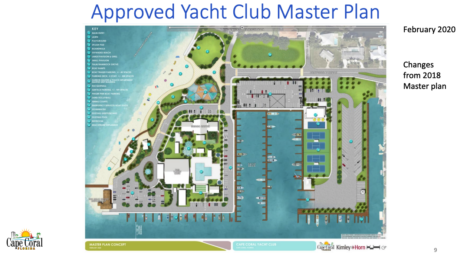
Public workshops were held, as well as individual meetings with Council members in October 2019 and January 2020. Master plan approval came in February 2020.
Wright Construction Group was selected to provide construction manager at risk services in May 2020, and 90% of plans were complete with a new estimate $52 million after plans were expanded to include such things as a parking garage.
Osterstock said based on the 90% design completion the project was $52 million and included the harbor building, three-story garage, seawall replaced and additional docks added for day docks. He said the council retreat in January 2023 determined that the damaged buildings be demolished and there was a need for additional parking, which resulted in the removal of the tennis courts.
A few months later, in September, Hurricane Ian made landfall and destroyed much of the infrastructure including the marina and outbuildings.
A new course
With Hurricane Ian came a new course — and a new from-the-ground-up opportunity.
A request for a new master plan took shape in January 2023, followed by a consensus from Council to reallocate all GO Bond funds to other projects and finance the Yacht Club improvements with other resources in March 2023.
The master plan was amended and developed in June 2023 to include a much-larger L-shaped parking garage, a harbor master building, a “resort-style” pool, new two-story community center to replace the historic mid-century “ballroom” and a little green space, as well as an additional pier that was not included in the original scope.
In May 2024, the updated master plan was approved and the design contract was amended for construction and permitting documents in July 2024. The updated master plan included a new community center, lifeguard/pumphouse, beach restroom, the expanded parking garage, harbor master building, maintenance building, both a resort and children’s pool and other site amenities.
“Fast forward to today we are approaching 100% development on the plans. Now is the time to decide how to build the remaining portion of the job site,” Osterstock said.
New cost estimates
As the design phase further progressed, additional estimates were given.
“The further you get along with the design the clearer the picture becomes and the better the numbers become,” he said.
The Yacht Club cost breakdown showed that the new floating and fixed docks to be $12 million, the fuel system and tanks $3 million and the harbor master building at $7 million. Osterstock said those three items were just to get the marina up and running – functionality for the marina.
Other costs include the civil site improvements/utilities for $35 million, parking garage for $38 million, beach restroom for $4 million, resort-style pool for $11 million, the lifeguard/concession and pump building at $7 million, maintenance building for $2 million and the community center for $45 million.
The seawall construction cost, which was already approved, sits at $22.8 million.
The design and permitting costs are $9.43 million.
There is also some CEI — construction engineering and inspection — costs – having a full-time inspector to make sure the seawall and everything else is built property at an estimated $1.20 million for four years for a total estimated cost of $197.43 million.
Councilmember Jennifer Nelson-Lastra said the plan gives her anxiety and she would like an opportunity to scale back some of the features.
“We wanted to do this based on the future. I get that. I totally understand that. We have another opportunity at the Old Golf Course. Perhaps we go back to simplifying the community center and put an additional community center at the Old Golf Course and pool and simplify that,” she said. “Bring back elements that were there originally. If we can scale something back on this and simplify it, I think the residents would be happier.”
Nelson-Lastra said the city should move full steam ahead on the marina and boat docks, so that part of the park can be enjoyed.
“The rest of it, scale it back a little bit and simplify it knowing we have an opportunity coming up with 175 acres,” she said.
Councilmember Bill Steinke argued that moving facilities from one place to another doesn’t save money, it just moves money.
Mayor John Gunter asked about the escalation in cost and what would be a realistic number for increases.
Robbie Powell, Wright Construction vice president of civil preconstruction, said basing it over the last couple of years, anywhere from 8-10% inflation cost would be a good guestimate.
“With that said, we are currently seeing some subcontractors that want more backlog. I don’t know what that does for prediction of increased cost in the future. There is opportunity in 2026. I am a believer that we have the opportunity to get more competitive pricing as we continue going down this road,” he said.
Gunter said at 10% inflation, the docks, fuel system for the docks and harbor master building, which is about $22 million, would be additional $4.4 million if the council waited two years. He said hopefully they have some interest for the private public partnership.
“It all comes down to the dollar amount. What we can live with. Once you figure out what you want to spend, you can figure out what you can build and what you can’t,” Gunter said. “The first of the year is when we are going to have to decide that multi-million dollar question. What we are going to do and not do.”
To reach MEGHAN BRADBURY, please email news@breezenewspapers.com