

Cape Coral: Waterfront wonderland with not nearly enough water infrastructure
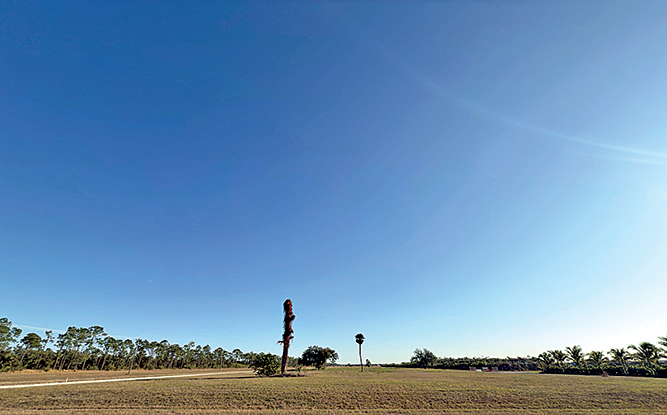
Cape Coral–Vibrant green grass, radiant red hibiscus, and sturdy royal palms crown South Cape Coral’s coastal community. Turning onto Santa Barbara Boulevard heading north from downtown Cape Coral Parkway and driving up the nearly 11-mile stretch of road, one cannot help but notice the stark contrast. Once luscious green pastures crunch under any resident’s feet, both wild and tamed. Residential properties remain sprinkled with dehydrated hibiscus petals previously teeming with honeybees. Once tall and robust royal palms no longer dance freely in the coastal breeze. This is the reality for much of Cape Coral’s northeastern region and its residents.
Lack of water infrastructure in the city of Cape Coral has affected hundreds of existing residents as the city continues to exponentially explode forcing many to run their private wells under irrigation restrictions. It has gotten to the point where residents are considering leaving.
“I mean, I own a business and everything I have, I will uproot it and take it with me,” said Abby Price, a longtime resident of northeast Cape Coral. “I am getting out of here. And part of the reason, I mean, especially if I got taxed with the $20,000 to $30,000 assessment fee and it’s just not something I’m interested in.”
The entirety of Lee County has been under a water shortage warning since November 2023. The South Florida Water Management District issued this after a significant deficit in Lee County rainfall starting in 2023.
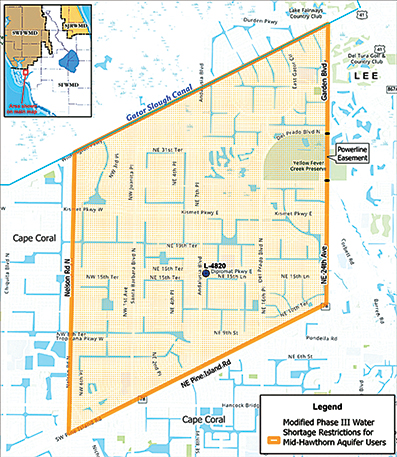
Following this, SFWMD also declared a severe water shortage aiming water restrictions at those living in northeastern Cape Coral due to critically low water levels in the Mid-Hawthorn Aquifer.
Sean Pearce has been a resident of Cape Coral for three years and deals with these irrigation restrictions firsthand.
“I am pretty sure that there is like, you can’t be watering your yard, just willy-nilly whenever you want,” Pearce said. “Our yard is watered once a week, like I believe ours is set up to be proper.”
These regulations are only expected to intensify as Cape Coral grows.
Based on 2023 census numbers, the population of Cape Coral is 224,455 residents. By 2050, the city’s planning division expects a population of 318,503 residents.
With population growth, city infrastructure often follows suit accommodating the new members and structures of a community. But many residents feel the opposite is unfolding in Cape Coral.
“I would say no, they are more focused on just building the houses while not improving the infrastructure to support that,” Pearce said.
Stephen Cohen, a retired firefighter and prior resident in north Cape Coral, shared this same sentiment.
“In my mind, because the five years that I was here and living as a homeowner, and the time I lived here before that, I’ve just watched the growth explode here and their water resources are dwindling,” Cohen said. “And they’re not slowing it down. Even since I’ve been down here on vacation, it seems like there’s a lot more houses built and a lot more for sale.”
The approximately 18 square miles under this declaration is underdeveloped, lacking potable city water and sewage services. Depending on private wells, residents utilize the Mid-Hawthorn Aquifer as their primary water source.
According to SFWMD, if the aquifer’s water levels fall too low, permanent damaged may affect its potential future water supply.
SFWMD provided no response after repeated attempts requesting a statement.
The city of Cape Coral did respond, emphasizing the need to adhere to watering restrictions as it works to bring municipal utilities to unserved areas.
“It is critical that residents in the specified area follow the one-day-a-week watering schedule,” city spokesperson Kaitlyn Mullen said. “Many in this area are on private wells; for most, their irrigation and drinking water are pulled from the same aquifer.”
Cohen has dealt with a similar issue before and hopes Cape Coral leaders can draw from his prior experience.
“When I lived in Virginia Beach, Virginia, they put a moratorium on building up until they got Lake Gaston as a main water supply,” Cohen said. “And you know, they, they slowed down the building until they took a handle, and it hurt, but it was, it was something they had to do.”
This may seem easy, but obstacles prevent this from becoming a reality.
“Property owners with proper land use and zoning for single-family homes have legally protected rights to develop their land,” Mullen said.
Cape Coral’s utility expansion projects aim to tackle the infrastructure issue without imposing a moratorium on building new construction.
The city’s ongoing UEP brings sewer, irrigation, and water services to originally untapped areas of the city.
Various water services provided include fire hydrants, master pump stations, and new lift stations while existing roads and storm drainage systems are reconstructed to accommodate the new infrastructure.
“There is a light at the end of the tunnel– the North 1 UEP will be completed in 2027, addressing about 75% of the impacted area,” Mullen said. “The North 6 UEP will be constructed in 2030, taking care of the remaining 25%.”
Mullen also mentioned that by 2030, city council is hoping the situation will be mitigated.
But even then, some residents may not want to be incorporated into city water infrastructure and remain on well water.
Price strongly feels this way.
“I love it. In the 16 years that I have owned my house in Cape Coral, we’ve probably spent less than $2,000 on any repairs and maintenance and that’s including even having to replace the well pump,” Price said. “We spend probably $40 a month on maintenance.”
All this talk about expanding Cape Coral’s water infrastructure has perturbed Price, even pushing her to move from her longtime residence.
Part of this is due to the per-property price for the UEP, which is imposed on properties that will receive services from the endeavor.
According to the city, amortized low- interest loans provide an affordable means for property owners to pay the bill over 20 to 30 years.
For reference, the current UEP under construction, the North 1 West UEP, imposes two combined fees on homeowners. For each parcel measuring 10,000 square feet, a total of $26,617 for a land area assessment fee and a total of $6,750 for a capital facility expansion charge will be levied on the property itself.
These assessments are subject to change as the expansion continues to new unserved areas of the city.
“I think more can be done,” Cohen said. “I don’t know why they are handicapped, or in what way they are handicapped from doing that.”
Sandra Hallman, also a homeowner in northeast Cape Coral and retired police officer from Chicago, shares a similar perspective.
“I don’t know how single-family homes, because you know Florida is not a big-paying state, make it with kids,” Hallman said. “It’s got to be rough.”
This leaves many families like Price’s with priorities to weigh and decisions to make.
“You know, hey, you’ve got a bill for $40,000. Well, I don’t have $40,000 to give you,” Cohen said. “Well, we will charge you more in your taxes. Well, I don’t have the room for you to put it in my taxes. What are they going to do?”
Samuel Brucker is a journalism student at Florida Gulf Coast University. He has been a resident of Cape Coral for more than 14 years.