

CROW reunites rehabilitated purple martin with Cape Coral colony
Swallow recovers from plastic-impalement injury at the Clinic for the Rehabilitation of Wildlife on Sanibel
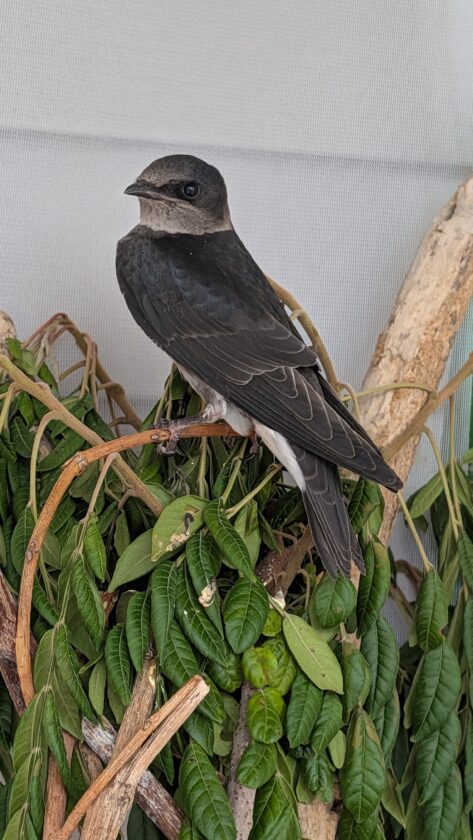
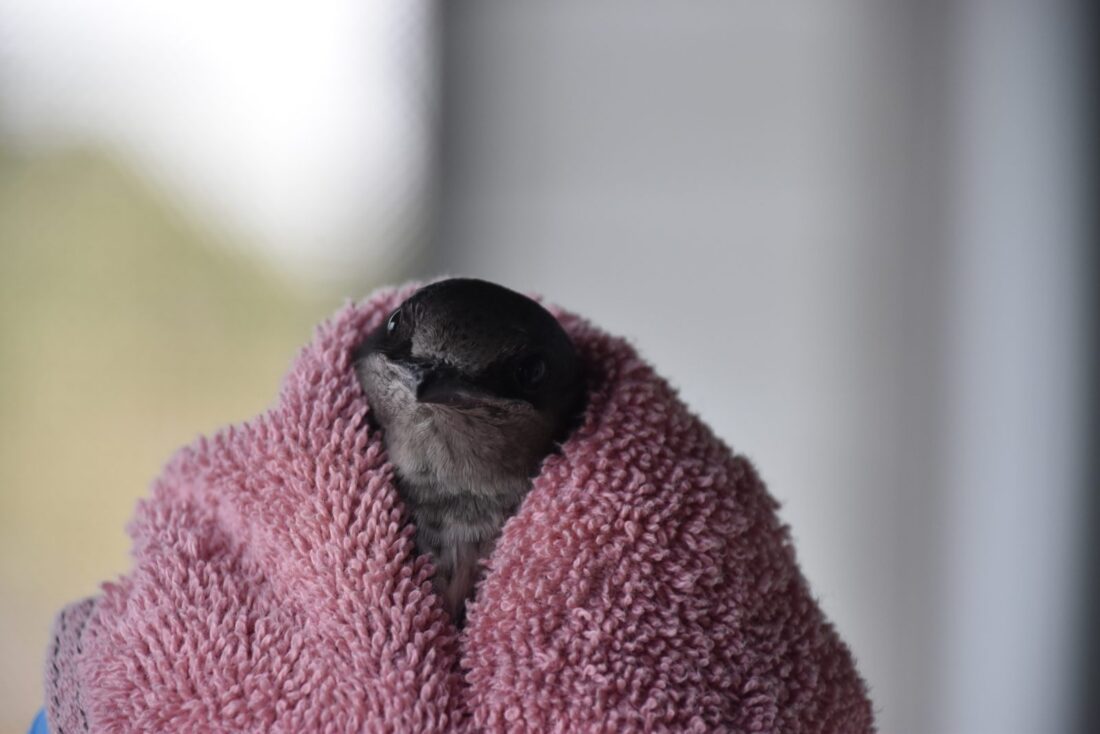
The purple “Prince” of his colony has returned to Cape Coral.
A piece of plastic no larger than a few centimeters nearly ended the life of one young purple martin. Weeks later, that same bird soared back into the skies over Cape Coral, rejoining the gourd colony it calls home.
The juvenile purple martin, who was dubbed “Prince” by his rescuers, was found struggling in a Cape Coral canal in June. Once at the Clinic for the Rehabilitation of Wildlife on Sanibel Island, veterinarians discovered a piece of plastic embedded deep in the bird’s chest. Because the wound had already begun healing around the foreign object, the plastic had to be surgically removed before the bird could start its recovery.
“Even a small piece of plastic can cause serious injuries to wildlife,” said Dr. Rodney Schnellbacher, CROW’s senior staff veterinarian. “Although the wound had already begun closing around the plastic, it couldn’t heal properly until the foreign material was removed. After weeks of wound care, rehabilitation, and carefully monitoring the bird’s recovery, we were thrilled to see it healthy enough to return to the wild.”
Releasing purple martins, however, requires extra planning.
Unlike other birds, which are often released in suitable habitat near where they were found, CROW tries to return each purple martin to an established colony.
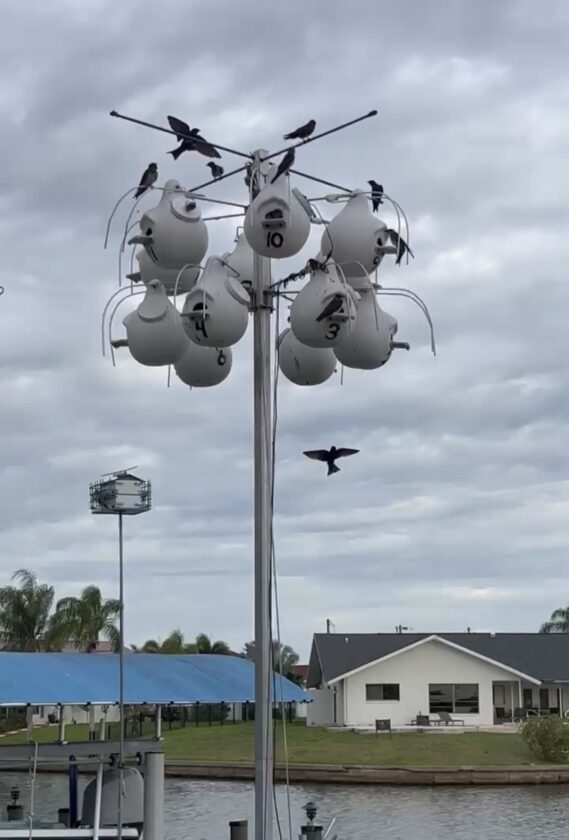
Purple martin colonies exist almost exclusively in intricate manmade birdhouses called “gourd racks.” These racks are suspended white gourds mounted at the top of 12-foot-to-20-foot poles.
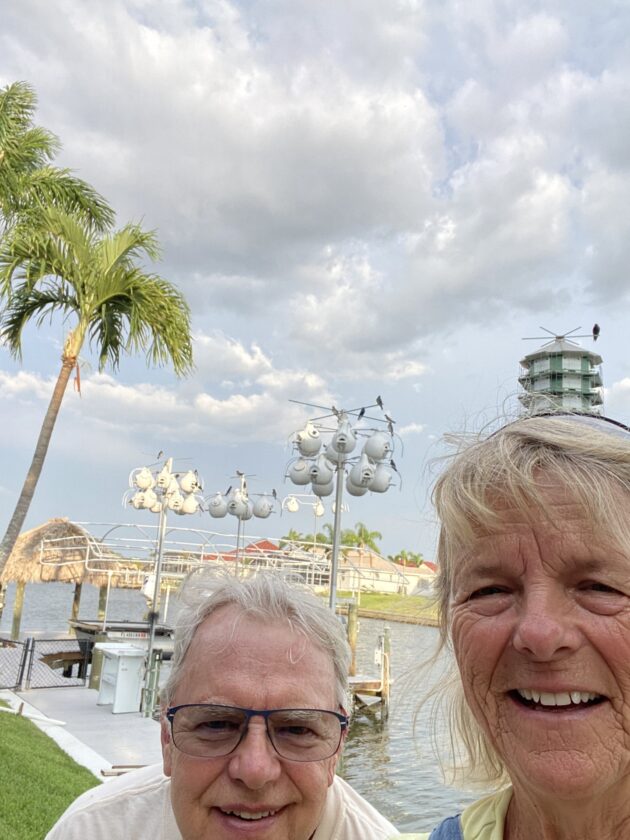
In Cheryl Anderson’s backyard in Cape Coral, four of these gourd racks loom above the canal. Purple martins perch and dart into the hanging numbered white gourds, usually twittering madly. With the help of two CROW volunteers, Anderson released CROW’s patient on her property in June, reuniting the martin with the rest of the colony.
Anderson and her husband, Jim Collier, have been purple martin “landlords” for 50 years and have helped set up other gourd racks around Cape Coral. Anderson quips that neighboring racks are “less than half a mile away, as the purple martin flies.” These separate colonies often mingle together in large roosts each morning and evening.
Anderson has worked with CROW on past wildlife patient releases, including purple martin releases like this one.
“We appreciate all the work that CROW does,” she said.
Since 2013, CROW has treated more than 40 purple martins at its nonprofit wildlife clinic. Research indicates the species eats around 262 billion insects each year.
Anderson watches her purple martin colony roost every morning.
“We hope Prince is out there!” she said.
This release represents just one of thousands of patients treated by CROW yearly. In addition to birds like purple martins, CROW rescues, rehabilitates, and releases native and migratory wildlife, such as raccoons, sea turtles, bobcats, and bald eagles.
Anyone who finds a wild animal in need of help can call CROW at 239-322-5068. The wildlife hospital is open 7 days a week and is at 3883 Sanibel Captiva Road on Sanibel Island. For more information, visit crowclinic.org.
About CROW
Clinic for the Rehabilitation of Wildlife (CROW): Founded in 1968, the Clinic for the Rehabilitation of Wildlife (CROW) is a nonprofit organization dedicated to saving the sick, injured, and orphaned native and migratory wildlife of Southwest Florida and beyond. Through veterinary care, educational programs, and a visitor center, CROW strives to improve the health of wildlife and the environment. Its state-of-the-art Harkey Sea Turtle Complex is anticipated to open in 2026. For more information, visit www.crowclinic.org. If you find a wild animal in need of help, call (239) 472-3644 ext. 222 or visit https://crowclinic.org/found-animal.