

All Smiles | Habitat for Humanity makes home ownership dream come true
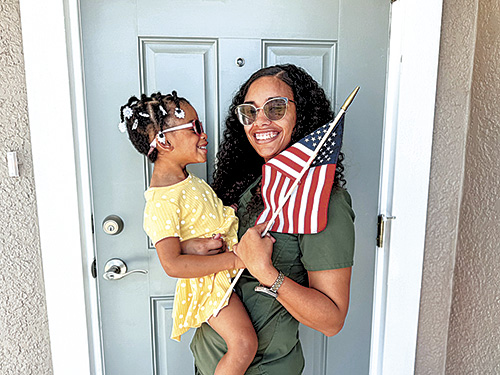
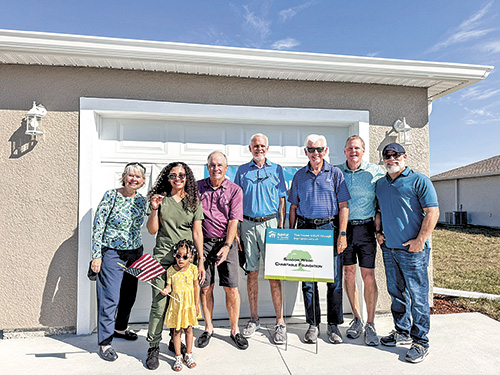
A first-time homeowner has fulfilled her dream of giving her daughter stability through Habitat for Humanity of Lee and Hendry Counties at McNeill Village on the border of Cape Coral and North Fort Myers.
“It still feels so unreal. I have been there since the beginning of April. I still don’t think my baby knows it is my house. It is exciting. What I want for my house and decorations —- and know I don’t have to ask anybody —- I feel like a teenager playing house right now,” Malanie ‘Lanie’ Bryant said. “What I definitely love about Habitat —- the community aspect of it —- so nice and welcoming. They made me feel very confident in myself that I can do it and they are still there for you, if you have questions. I love that. I actually know my neighbors and got to experience it together.”
She learned about Habitat for Humanity a few years ago after helping one of her friends paint her house. Bryant said she wanted to give her daughter, Journie, who is now 3 years old, stability.
“My grandparents had their house since my mom was 10. I wanted that for her,” she said. “My godmom ended up getting a Habitat home and telling me how great it was. She talks about it all the time.”
Her godmother continued to push her into looking into Habitat, which ended with her applying in January last year and getting approved in July. Following orientation, she began doing her volunteer hours and began to meet her neighbors.
A total of 300 hours were completed all together. She said one of the women that she started the Habitat for Humanity process with, who lives two doors down from her, helped after her hours were finished.
Shadow Wood Charitable Foundation, which is one of Habitat’s longtime gated-community partners, sponsored her home and volunteered on the build site through the process. Bryant said she got to put down her floors and raised the walls of her home.
Habitat for Humanity of Lee and Hendry Counties Vice President of Resource and Development Cece Willis said McNeill Village is on the border of Cape Coral on Pondella Road, very close to Pine Island Road. She said there is ample access to schools in the area, houses of worship, plenty of grocery stores and public transportation.
The 36-home neighborhood is a homeowner’s association-managed community. Willis said they have established a homeowners association and handed it over to the residents to serve on the board and influence change in the community and take over governance as well.
The final home of the neighborhood will be closed by the end of June.
“That will be the last home of the 54 that we have completed in our ’25-’26 fiscal year. That is a huge milestone for us,” she said.
McNeill Village is the first project that Habitat for Humanity has partnered with Lee County on the Community Development Block Grant for Disaster Recovery (CDBG-DR), which was allocated to the county after Hurricane Ian to be invested in the creation of affordable housing.
Willis said it is a reimbursable grant.
“The county has been a phenomenal partner,” she said. “We are proud to close out that project and neighborhood. We had some really amazing donors, volunteers, and supporters come through and really help bring this neighborhood to fruition to help us achieve the completion.”
The project was split into two phases with the first one starting in 2023 —- the development of the neighborhood, including the infrastructure. The first half of the homes, 22, was completed about a year ago. This fiscal year, 14 homes made up the second phase.
The neighborhood includes Patino Park, a green space, in honor of Eduardo Patino, construction project manager, and a Habitat homeowner who started as a volunteer in 1999 before becoming a full-time employee in 2001.
Every stage of the construction of Bryant’s home was photographed – from the cement foundation to the walls going up and every other stage of completion.
Before moving into her very first home, Bryant said she was staying with family members. She said her mother passed away, she was a first-time mom, and her child has medical issues, so living in one bedroom, of the four bedroom house, with her daughter was helpful.
“When you are in someone else’s home, you don’t want to be too loud, or break something,” Bryant said, adding that now they can be a little freer, which is great.
Now, they go for walks around the neighborhood with their neighbors.
Willis said families come to them by filling out their intake packet, specifically for their HUD-approved counseling agency.
“We want them to first come through the pipeline with the intake packet and meet one-on-one with our housing counselor,” she said, which highlights such areas as their goals.
A personalized action plan is created to help them achieve their goals. If the goal is ownership, Willis said then they make sure they are homebuyer ready, so they are prepared for the process.
Once they are assessed and ready, they submit a pre-application, which is the key to applying for a home specifically with Habitat. Willis said they can submit the pre-application with the home and location they are interested in pursuing.
“That way they can apply for a home in a place they want to live and make sure that is somewhere they are committed to planting roots so they can be sustainable,” she said.
The selection is done through the most unbiased process they can create —- a volunteer selection committee. Qualified families are based on their need for better housing, ability to pay mortgage and willingness to partner with Habitat.
Once they enter the program, all the families will complete some main criteria, one of which is meeting regularly with the housing counselor. They also must complete 300 sweat-equity hours where they can volunteer on their home, a neighbor’s home, or in one of the Restore locations, the retail store. There is also 22 hours of homeowner education, so they are prepared for all the financial pieces that come with homeownership, including home maintenance education classes.
Another component is the qualified family member contribution of $2,000 towards their home’s closing cost, Willis said.
She said that is pretty unheard of and is at a discounted closing rate.
“It is attainable for so many families because there is no down payment —- only the $2,000 in closing cost they contribute to and Habitat manages the rest,” Willis said. “Once all those pieces are completed, and the home is finished and we go to the closing table, we will help facilitate that affordable mortgage and homeowners are set at no more than 30% of their income and that is going to include the mortgage and escrow.”
That affordability includes property taxes and, for Bryant, homeowners’ association fees because McNeil Villages has the association.
“We have really seen that be successful over the years and are committed to continuing that education,” Willis said. “Less than 1% foreclosure rate. This program works. We’ve seen that impact on each individual family and what that looks like for each family — the data and numbers show that proof of concept as well.”
The need for affordable housing remains in Lee County.
She said there are a lot of conversation around the housing market stabilizing in the area over the last couple of years.
“What people don’t necessarily realize, unless they are experiencing it, is it is still expensive and out of reach for many people,” Willis said. “Even though the market has stabilized, the average house price is still five times the amount of the median income in Lee County. That is still a pretty alarming gap. That is where we know there is a large need.”
The families that continue to come to Habitat often times pay more than 30%, or an upwards of 50% of their income to have a roof over the heads. She said that is alarming, especially when there are other necessities.
“It solidifies the purpose of our mission and how important it is to continue to build homes, neighborhoods and even housing counseling,” Willis said.
She said that remains the hope element of their mission —- having Habitat as a resource and support for those who feel homeownership is out of reach.
Habitat became a part of the community in 1982 and next fiscal year they will build their 2,000th home. This is made possible through the people in the community —- the county, sponsors, individual donors and volunteers building homes and donating time.
“Their passion towards this is pretty incredible,” Willis said.