

The Tom Allen Memorial Butterfly House at Rotary Park is a popular attraction
By FRANK FANTINI
Special to The Breeze
Question: What is 625 square feet, has scores of residents and receives 100 visitors a week from throughout the world?
Answer: The Butterfly House in Rotary Park.
Or, more formally, the Tom Allen Memorial Butterfly House operated by the Cape Coral Friends of Wildlife.
Enter this small, screened enclosure and you enter a world unimagined by those looking in from the outside just a few feet away. You immediately are surrounded by lush green plants, including species that date to the age of the dinosaurs, and, of course, by butterflies, those beautiful little creatures that quietly flutter around you.
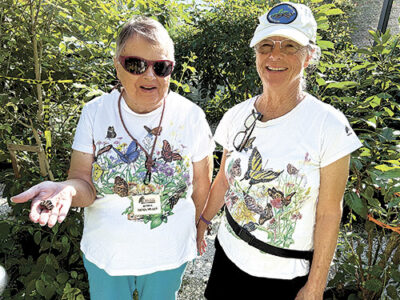
You also are greeted by enthusiastic volunteers like Cheryl Anderson and Carol Miller.
Though both have volunteered at the Butterfly House for many years, they describe its charms with the ardor of new admirers.
Anderson, who is butterfly house curator, describes the various butterflies now present. They include Florida’s state butterfly, the zebra longwing, the always popular giant swallowtail, and the perennial favorite, the monarch.
“I can talk about butterflies all day,” Anderson said in the soft drawl of her native Fort Worth, Texas.
The Butterfly House is more than a home for the beautiful insects. It also serves as an educational center that produces positive environmental results. Visitors learn that each butterfly species has its particular host plant that is a native species.
Many visitors leave motivated to buy those native plants to attract their own butterflies, Miller notes. As pollinators, the butterflies help the plants spread, which leads to more butterflies, which leads to more plants. That becomes a virtuous circle for creating healthy local environments.
The Butterfly House itself is something of a nursery. The volunteers use donations to buy various plants that attract the different species. They nurture the insects through their life cycles from eggs to caterpillars to chrysalis to butterflies, then release some of them and start the nurturing process all over again, often introducing new species.
Interestingly, the most popular resident of the Butterfly House isn’t a butterfly at all, but a red footed South American tortoise, named, appropriately, Captain Red Foot.
The Captain is especially popular with children, who can’t resist petting the friendly fellow.
He also is the subject of Anderson’s favorite story from her many years as a Butterfly House volunteer.
“This little (disabled) girl came in one day on crutches. She was maybe 5 years old and wore these big glasses,” Anderson recalled. “She saw The Captain, reached over and petted him, and then stood up without (her) crutches. It was the first time she had ever stood up without crutches or a walker,” according to her mother.
For that, The Captain was cited as volunteer of the month, Miller noted.
Then there are the human volunteers essential to an operation that relies on their contributions of time. They range from master gardeners to docents like Anderson and Miller.
Several have lent significant scientific knowledge, such as “Botany Bob” Dennis, a Ph.D. in paleobotany, the study of ancient plants.
“He was a big-time butterfly guy,” Anderson said.
Volunteers include students, such as Cape Coral High School freshman Lillian Lovejoy, who contributes her time as part of her Baccalaureate International community service requirement. Volunteering at the butterfly house is a “real sweet” deal, she said.
The first volunteers were those who built the butterfly house more than a decade ago.
Anderson remembers being in Rotary Park when she saw three men constructing the screened enclosure. Among them was the late Tom Allen, an entomologist renowned for his knowledge of butterflies. The others were Michael Orchin and Ed Donaldson.
The house has been upgraded over the years with later volunteers adding a concrete foundation and unique screen system among the enhancements.
As might be expected, Hurricane Ian badly damaged the butterfly house. Again, volunteers rebuilt it. Ian also swept out several butterfly species. Replenishing the variety of species remains a task in process.
In addition to such volunteers, Anderson is quick to add the Cape Coral Parks Department and its employees to her thank-you list for hosting the Butterfly House, which operates in Rotary Park free of charge.
The butterfly house is open to the public three days a week. However, it is open 24/7 for viewing by webcam on the Cape Coral Friends of Wildlife website.
On the morning of meeting Anderson and Miller, the house was open for tours. As the 10:30 a.m. opening time arrived, a line of eager visitors already had formed. A writer decided to put Anderson and Miller’s claims of the house’s wide attraction to the test.
“Where are you folks from?” he asked the first two visitors.
“Germany,” the man replied. “And she’s from the Netherlands,” he said of his companion, who happened to be his adult daughter.
Point made: The Tom Allen Butterfly House is a draw for visitors from throughout the world, right here in Cape Coral.
—
Rotary Park is at 5502 Rose Garden Road in Cape Coral.
For more about the Cape Coral Friends of Wildlife, visit ccfriendsofwildlife.org.