

Renner seeks nod in GOP primary for Governor
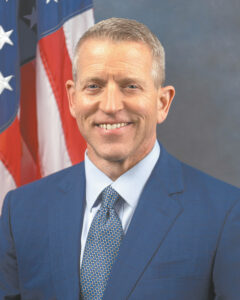
Editor’s Note: This week, Breeze Newspapers is profiling Paul Renner, who is running in the Aug. 18 Republican primary for governor. Breeze Newspapers previously covered Lt. Gov. Jay Collins and Congressman Byron Donalds, two of the other leading candidates in the GOP primary.
For former Florida Speaker of the House Paul Renner to succeed Gov. Ron DeSantis, he will first need to mine through a field of 10 candidates in the Aug. 18 Republican primary.
That job will at least be safer than the mine-sweeping work he did in the U.S. Navy during Operation Desert Storm 35 years ago, and his military service in Afghanistan 20 years later after being called back into service with the U.S. Navy Reserves.
“I am very proud to have served, and I was privileged to have served. I loved the men and women I served with, and I wouldn’t trade it for anything,” Renner said.
Now, 59, Renner is seeking to re-enter politics at the highest state level after being term-limited out of his state legislature seat last year. After leaving office, Renner was appointed by DeSantis to the Board of Governors for Florida’s State University System. Renner served as speaker of the State House for three years, while representing Flagler County in northeastern Florida. Flagler is an attorney and former state prosecutor.
On the campaign trail for governor, Renner said voters are telling him that the main issue on their minds is the cost of living.
“Affordability is very much a top issue,” Renner said. Cutting property taxes, tackling electric rates, and property insurance costs are two of the ways Renner thinks he can make a difference in the pocketbooks of Floridians.
Renner wants to eliminate homestead property taxes up to $1 million of a property’s value. That would be substantially up from the proposal on the state ballot this November to make a Constitutional amendment to raise the homestead exemption es from $50,000 to $250,000 of a property’s value. The measure would not include school taxes, which Renner wants to see included.
Renner said he wants to take care of long-term residents with a five-year wait for newcomers. To make up for the revenue loss to schools and municipalities, Renner said he would shift the burden to private equity investing in turning homes to property rentals, tourists and other visitors to Florida.
Renner said the largest revenue shift he is proposing would be a one-time fee on the purchase of a home or business.
Renner said he wants to also provide assistance to renters and businesses, who wouldn’t benefit from the homestead exemption.
To make up for the loss of revenue to municipalities and schools, Renner said the “state will have to help with this process” through state surpluses. He would like to see the state assist municipalities in financial distress. Renner thinks the state can also find savings in Medicaid through going after “fraud, waste and abuse.”
Renner said he wouldn’t comment on whether he supports the current referendum.
“I haven’t opposed it, I am not going to be out campaigning for it,” Renner said. “I am not against it. I think they could have done a much better job.”
Renner said the proposed homestead exemption amendment “looks a little half-baked.”
Renner said he thinks the amendment “fails on two fronts. It fails on the benefit front not going far enough, to truly make sure you don’t lose your home if you get sick, lose your job or make a fixed income and can’t pay the property taxes.”
Renner said there is no backup in the bill for fiscally constrained municipalities if they lose a catastrophic amount of property tax revenue. Lee County is forecasting more than $240 million in lost tax revenue for 2028.
Renner said property taxes have gone up too far in Florida.
“Government shouldn’t grow faster than our incomes,” Renner said.
Renner said Florida Power and Light’s request for a rate hike this year, which was partially granted, was an example of an issue he wants to tackle. Renner said he wants to slow the rate of utility hikes.
Hurricane Ian hit Lee County while Renner was Speaker of the Florida House.
“I did a lot during my two years of Speaker,” Renner said. “We delivered the greatest hurricane relief package in Florida history.” Renner said “I told people we were not going to forget about them.”
Renner said he realizes that the recovery from Hurricane Ian is still continuing. “I realize that is not complete yet,” he said.
Renner said there are municipalities in the Panhandle still recovering from Hurricane Michael.
“I will finish the job to see that whatever needs to be completed, is completed,” he said.
With the threat of overdevelopment being called a top issue by Lee County commissioner candidates, Renner says that is a top concern of his, too.
He called himself “a committed conservationist.” Renner is sensitive to data that has shown some of the development projects in Lee County, such as the Kingston development in Estero, and others in nearby Collier County, could lead to more deaths of the endangered Florida panther.
“I championed the Florida Wildlife Corridor. We spent more to protect and conserve Wild Florida including those panther lands than any legislature before or since, over $1 billion and counting. We put some money in recurring funds to continue to conserve land. I am committed to completing the Florida Wildlife Corridor and part of that means you are not building on it, you are preserving it.”
Renner said Floridians “don’t want to see the Florida they love paved over.”
Renner said he is also concerned about the state legislature taking too much power away from local governments.
“I am concerned about the issue of local control generally. I think the pendulum has swung too far in Tallahassee. We need to make sure we are not taking away the powers that historically have been left to local government,” Renner said.
“We have grown too far, too fast,” Renner said. He said he is committed to the Florida Everglades restoration, and called water quality a top issue of concern for him as well. “You can make the environment better through smart steps,” Renner said. “Once you destroy it, you don’t get it back.”
Renner is calling for a statewide moratorium on new AI data center construction to protect consumers, workers, and the environment. He pointed to rising energy demands, increased strain on water supplies, and the likelihood of higher utility costs as immediate concerns for Floridians.
“The push for AI Data Center developments is a reckless gold rush,” Renner said. “Big Tech and major utilities are pushing massive data center projects at a pace that outstrips oversight, transparency, and common sense. As governor, I’ll stop it.”
While Renner’s service started in Operation Desert Storm, it didn’t end there. He left to enter the University of Florida Levin School of Law while also entering the U.S. Navy Reserves. After working as a state prosecutor and as an attorney in private practice, he was called back into active duty during the Iraq War to work out of Washington D.C., and served in Afghanistan in 2011. He retired from the U.S. Naval Reserves with the rank of commander in 2013.
He had a recent meet-and-greet in Cape Coral and spoke with the Republican Club.
There are 11 candidates in the Republican primary for Governor. Several polls have Congressman Byron Donalds (R-Naples) ahead of the field. Donalds has been endorsed by President Donald Trump, and has been staunch supporter of the president. Lt. Gov. Jay Collins, another candidate with strong support, is suing candidate James Fishback, to have him removed for the ballot for allegedly not meeting the residency requirements for governor.
Other Republican candidates in the field include Jim Holcomb, Arthur Joseph McCaffrey, Daniel Nokovich, Rachel Rodriguez, James Shaw, Caneste Succe, and Bobby Williams.
To reach NATHAN MAYBERG, please email nmayberg@breezenewspapers.com