

Fundraising campaign underway to benefit SEA STAR Program
Donations to support Golisano Children’s Hospital's autism initiatives welcome
The SEA STAR Program — Safety, Education, Awareness, Sensory Training — Autism Readiness — is the benefactor of tonight’s 10th annual MarineMax Yacht Gala: A Night Under A Million Stars.
For those still looking to contribute, donations are welcome at www.leehealthfoundation.org.
Lee Health Foundation Director of Development Justin Brand said the fundraising event has raised more than $2.2 million to date. The focus of the funds this year will benefit the SEA STAR program, which is essentially an initiative that is used inside their pediatric locations to support individuals with development disabilities – autism – so they can receive the best care possible.
In 2024, a sensory-friendly care program was launched through the Golisano Children’s Hospital for children with autism spectrum disorder. With the launch of the SEA STAR Program, the Golisano Children’s Hospital became the first Certified Autism Hospital in Florida.
The hospital was also the first in the country to introduce its sensory-friendly ambulance.
Brand said from there they started creating the initiative where they incorporated sensory rooms, sensory registration areas, patient rooms and sedation rooms.
There are seven mobile sensory units, which enable the hospital to transform any room with this sensory-friendly environment. There are also 10 multi-sensory treatments across sedation services, emergency department, pre-op, medical surgical unit, general pediatrics, classroom, oncology, pediatric intensive care unit and the Naples clinic.
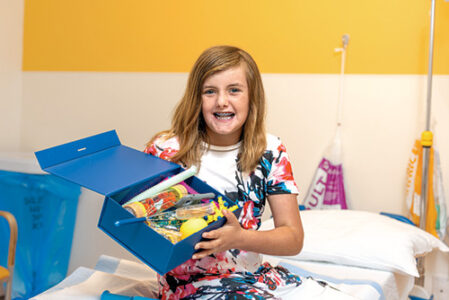
In addition, when patients are identified as autistic, or within the spectrum, they are provided with a soothing sensory item — the little blue box — a small toy box that has fidget spinners and textile toys to help.
The kit addresses eight wellness dimensions and eight senses. There are also sibling kits to promote learning and inclusion.
Brand said about one in six children experience sensory sensitivities and the program addresses a real, growing need in pediatric care.
The program is communicated through the child’s physician.
“If the physician knows the child would benefit through the services, they let them know,” Brand said. “We flag them in the system. We know when they come in for registration, an X-ray, or blood draw.”
He said registration staff provides, or offers, the child the blue box to make their experience a little better.
The funds from the February event will help expand the number of sensory rooms inside the emergency department.
“It will help us better organize the waiting room in our emergency department,” Brand said.