

700 Mariner High JROTC cadets pair up with Community Cooperative to fight food insecurity
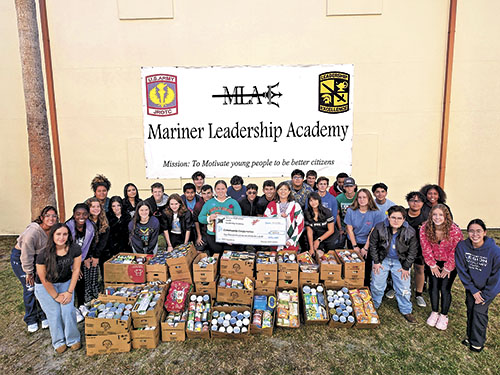

More than 700 JROTC cadets at Mariner High School are addressing food insecurities in Southwest Florida through a Service Learning Project they kicked off last month and will end at the end of February.
Brig. Cmdr. Jakobe Changasie’s job for the project is to look into the future and plan the events from ground one. After doing research and finding out that one in eight people in Southwest Florida suffer from food insecurity, it became the focus of this year’s Service Learning Project, he said.
Maj. Bryan Williams, retired United States Army major, is the Senior Army Instructor and Department Head of the JROTC Mariner High School Leadership Academy.
JROTC is a leadership and character education elective course in high school. There are more than 3,000 JROTC programs in the United States and of those, 1,700 are Army JROTC. The School District of Lee County has the largest JROTC program in the world.
There is an annual requirement in the curriculum to conduct a Service Learning Project, a community service project is where an activity is performed. The project is completely cadet led, planned and implemented with reflections along the way of learning about the problem, taking on leadership and logistics, Williams said.
The project has partnered with Community Cooperative, a nonprofit organization that has food banks located around Southwest Florida.
“A lot of planning and prep started the year before,” Changasie said. “We figured, even at the end of last year going into this year, that focusing on food drives, and a full partnership with Community Cooperative, would be the best route.”
The project initially started in the middle of January when they began setting things up with Community Cooperative and getting everything ready.
Community Cooperative was invited to the leadership honors classes to talk first to the top leaders to put a plan together and be prepared. Community Cooperative was invited back a second time to talk to all 700 students as the kickoff of the Service Learning Project.
Battalion Cmdr. Elyssa Vazquez said a lot of community outreach took place to get ready for the project.
“We wanted to make sure all of our cadets were able to participate in this project,” she said. “In order to do that, we made sure we had opportunities for everyone to join in on.”
Vazquez said cadets went to Community Cooperative’s food bank in Cape Coral on certain days. This allowed the cadets to see what their help goes towards and how they are impacting the community.
In other words, Vazquez said they were showing the cadets the whole program – how to do it and prepare.
With 700 cadets across four grade levels and numerous class periods, the project had to be synchronized.
Battalion Cmdr. Maegan Saintil said they implemented three leadership styles for the project – direct, indirect and advocacy.
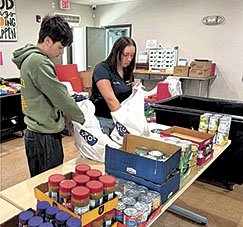
The direct approach allows them to go out into the community, go to Community Cooperative with a couple cadets to volunteer and help with meal prep and Meals on Wheels, Saintil said.
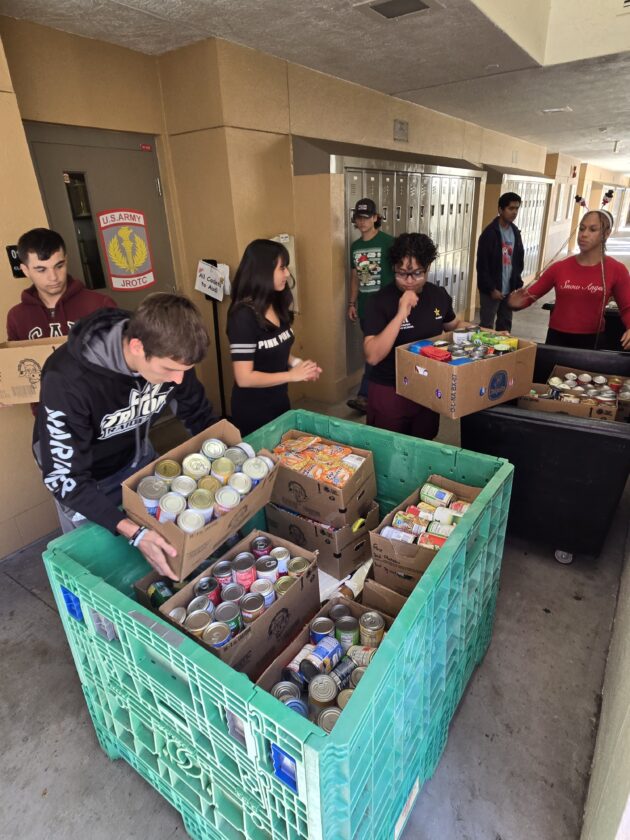
The indirect approach is done through cadets getting donations of food items – canned food items and nonperishable items like seasoning, cereal, pasta and cases of water – as well as monetary donations.
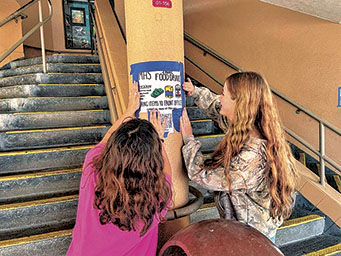
Advocacy was done through creating posters and fliers with QR codes and posting them on social media and around the school, Saintil said.
“Not only having cadets network with parents and other communications outside of school to get donations, but other students within Mariner High School that we show the QR code can take part in the Service Learning Project,” she said.
Cadet Victor Carillo said another advocacy component was going to stores and asking directly for donations. Walmart donated 800 pounds food items and cases of water. Publix on Pine Island Road also provided donations of multiple food items that were being picked up Thursday.
Another initiative the cadets came up with involved Farmer Joe’s on Pine Island Road, who has been a huge supporter of Mariner High School and JROTC, Williams said. They allowed the cadets to set up a table and solicit donations, which he said was quite innovative of the cadets.
It also was mutually beneficial — the cadets had the opportunity to explain their project and encourage patrons to buy extra food while shopping and donate it when they left.
“I am really excited about this. Kids are learning to be involved and motivate citizens. They are going out on their own. They wrote professional letters and made fliers and went to managers of the stores. It helps tell the story to the community,” Williams said.
Chief of Staff Zoe Enslin said the QR code helps with monetary donations, which has more value than, say donated, canned goods.
“The reason for that is $1 can get three pounds of food – they can buy a lot more food items compared to us giving them food. They can get more food,” she said.
Carrillo said although bringing canned goods and nonperishable food items is helpful, money helps more because Community Cooperative can buy the right food at the right place at the right time.
“They can have that backup of money for whenever they need to buy food instead of having food itself,” he said.
Another component of the learning experience for the young leaders is project management, Williams said. As they work their way through, or stumble their way through — which is another teaching moment — they have visibility of the current status.
Project management is critical with six class periods, and six classrooms per period for a total of 36 classrooms with 25 kids.
Changasie said although they currently do not have exact numbers, they have collected between 600 to 800 food items and $2,500. They receive a weekly update through the QR code.
Creating the QR code brought their project to another level.
The QR code provided a way to make a monetary donation directly to the project, Carrillo said. There were six QR codes created for each company, and then one large QR code for the brigade. By having seven different QR codes, it allows them to reach the most people in the most efficient way possible.
Changasie said the QR code is a good way to engage and put the project into vision. If the QR code reaches one parent who, in turn posts it to Facebook, it reaches a wider audience – people that may not have reached otherwise — and it brings more awareness to their project.
The QR code is also used on campus during A and B lunch. Saintil said each company has a day that they can set up a table, bring out their signs and posters with the QR codes.
“We are trying to get them to take part in what we are trying to do for our community,” she said.
Donations for the Mariner High School JROTC Service Learning Project maybe made at https://host.nxt.blackbaud.com/adaptive-donor-form/?formId=cae76335-2db8-49f1-84c6-2e2a4988c963&envid=p-nT8vaNJhXEuyTc4gWNgPOg&zone=usa&utm_source=qr_code.
Vazquez said the project runs the entire month of February. Once it concludes they will continue to advocate for food insecurity by continuing their collection of food items.
Throughout the project the cadets have learned many lessons.
“I would say overall, it definitely teaches us to really look at what we don’t see in the community,” Changasie said.
He said with one out of eight people suffering from food security in Southwest Florida, it could be someone in his class that may not know where their next meal will come from.
That thought has taught Changasie to appreciate what he has and get out in the community and help.
“I have learned how to get out into the community and give my support,” he said, adding that he is accessible even if he never meets the people he is helping.
Carrillo said another lesson the project has taught him is leadership – how to manage multiple people to go out and help the community. He said leadership is what they teach – teaching that giving does not always mean you have to provide things yourself.
Enslin said the project shows that teamwork is a valuable thing, especially when doing a project of this nature.
“Everyone has a role. If one person isn’t doing their part something is wrong with the project overall,” she said. “My company itself has been struggling with it a lot. That is one lesson I learned – teamwork is valuable.”
To gain that teamwork, the senior mentor of her company created group chats with leaders in her class period. Enslin said she kept them accountable and checked in on them and provided help and guidance.
“That really strengthened us as a group of leaders to motivate everyone else to do their part,” she said.