

Garden Club of Cape Coral | Common Florida weeds – part 3
By CATHY DUNN
news@breezenewspapers.com
It’s been a while since my last article on common Florida weeds was published, so a brief review is in order! What is a weed? Botanists usually refer to weeds as plants that are growing where we don’t want them – or “plants that are out of place.” Because weeds compete with more desirable plants for light, nutrients, space and water they are problematic – and they usually reduce the aesthetic appeal of our garden. Weeds can also be invasive or noxious (poisonous) plants that we don’t want in our landscape.
I have highlighted four common Florida weeds in my last two columns (artillery weed, creeping woodsorrel, America black nightshade and dollarweed). Today I will discuss dayflower and bittercress, two problematic weeds that you have probably encountered in your gardens.
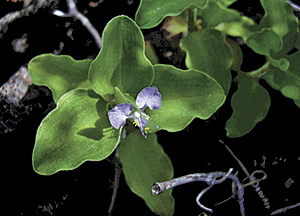
Dayflowers are common, hard to control weeds often found in Florida landscapes. The dayflower (Commelina benghalensis), or tropical spiderwort, is classified as a noxious weed which is difficult to control since it propagates rapidly by both stem fragments and seed. Dayflowers are not just abundant in Florida but are listed as one of the world’s worst weeds, affecting almost 90% of the crops grown on our globe! This weed was first recorded in Florida in 1928 and was designated by the USDA as a noxious weed in 1983. Because this weed is classified as a legally noxious weed, the presence of dayflower on nursery property can lead to quarantines; identification and management of this weed is therefore critical for commercial nurseries.
Native to Africa and tropical Asia, Benghal dayflower is present in many southeastern states and has been listed as a noxious weed by nine states, including Florida. This weed germinates during late spring and summer months; the leaves are egg-shaped (ovate) and usually have hairs on the leaves. This weed has both aerial and underground flowers! The aerial flowers are open and have three petals; the upper 2 petals are lilac or blue and the lower petal is lighter blue or white. These flowers are only open from early morning to mid-day, hence the name “dayflower.” I often encounter this weed in both my garden and my lawn; I usually spot these plants because of their broad leaves in the lawn and the purple flowers they produce. Unfortunately, these weeds must be completely removed; stem fragments can produce new plants. Whenever I spot these weeds in my lawn or garden, I carefully remove the entire plant – including the underground flowers and roots. This is a challenging weed and requires careful observation so that you can remove it before it spreads widely in your garden.
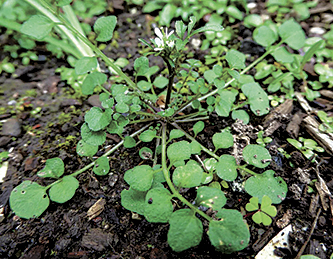
Bittercress is a very common weed with more than 200 known species that are present on every continent except Antarctica! Commonly known as lamb’s cress, spring cress or wood cress, these weeds are particularly problematic to nursery production where they can proliferate in greenhouses, growing media and nursery pots. Most often found in moist and shady areas, bittercress can also grow in full sun. You have no doubt seen these dense rosettes that assume an upright growth habit as they mature throughout your landscape.
The two most prevalent species of bittercress that are found in Florida are hary bittercress (Cardamine hirsute) and Pennsylvania bittercress (Cardamine pensylvanica), which is a native Florida landscape weed. Occurring naturally in 60% of Florida counties, Pennsylvania bittercress is a pollinator plant that is also a host for many insect pests. Bittercress produces small white flowers, and it is important to remove this weed before flowering occurs. Seed production is prolific, with one plant capable of producing five thousand seeds! Seeds are forcibly expelled upon maturity up to 6 feet and are sticky when wet which causes them to easily adhere to empty containers or even shoes and clothing. Unfortunately, bittercress plants begin flowering in as few as five weeks, and the seeds germinate quickly and can remain viable for several years.
Now that you can identify some of the more common Florida weeds, next month I will outline ways to manage and prevent these pesky unwanted plants!
Cathy Dunn is a Lee County Master Gardener Volunteer, Garden Club of Cape Coral member and president of the James E. Hendry Hibiscus Chapter.